Building Envelopes and Facade Systems
Bureau Built Expressions
| The building envelope, as the name suggests, comprises of all exterior components of a building namely, the roof, walls, sub-grade waterproofing, windows, skylights, external doors and so on. The envelope forms an integral entity of a building. Proper attention and care should be taken at the concept and design stages to prevent ingress of moisture, water and air through the |
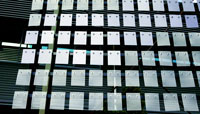 |
envelope. Each component, as a part of this external envelope has to be addressed and proper technology is adopted to get the desired results.
Each component of the building envelope must be reliable and also properly integrated with adjacent components to prevent moisture intrusion, such as roofs to walls, and walls to windows. Any and all moisture within the building envelope is a potential problem, including dripping water in interior spaces, deterioration of building envelope components, reduced insulation values, deterioration of structural components, and microbial growths.
The present article deals with that component of building envelope that is visible above ground as ‘fascia’ and commonly referred to as external building skin. Building Skins can be categorized under different heads based on the nature of materials used for this purpose.
In the present day context, myriad options available as building skins and in fact they form the most interesting components in contemporary architecture. Façades and building skins determine the visual identity, character and reflect the urban environment. Modern building skins designs range from simple, flat geometry to a complex 3D matrix. They display colours and moods of the people and spaces we live in.
The evolution of the building skin happened when rising energy costs in Europe and US during the 70s forced architects and manufacturers to develop new skin designs which could insulate the building more in their demanding climate. With the help of new computer aided programs testing methods and digital fabrication techniques, converting ideas into reality became much easier. Developments in material sciences made expensive materials like composites and displays more affordable for use on a large scale. This new found freedom sparked a revolution among architects to conceptualise newer and innovative skins which change the way a building interact with its context. The separation of the outer skin from the structure as we see now happened with the rise of industrialisation of building construction in the early part of 20th century, giving rise to the curtain wall of international style. Steel and aluminium members holding sheets of glass wrapping the building became the norm for offices and institutions alike1.
Facades
The façade of a building can be defined as an interface between inside and outside environments. It makes the internal space more habitable by allowing in beneficial elements of the external climate and restraining those that are less desirable for the internal spaces.
A facade is generally the visible face of an exterior of a building and the word comes from the French language, literally meaning "frontage" or "face". In the present day parlance, building skins and facades have become synonymous. Many names can be given to represent this external skin but the name-Facade System, is most commonly used in the industry.
The ever changing demands in respect of building skins are also pushing the research and
|
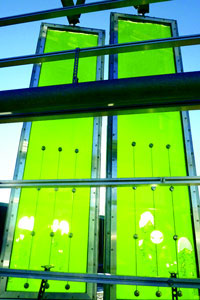
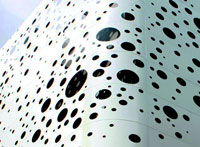
development to come out with new design methods, technical solutions, material compatibility etc. For this reason, the building façade is taking on ever-greater importance as high-performance materials and construction products involved in its creation. Primarily while designing any facade system, following performance parameters have to be taken into account.
-
Structural behaviour
- Interaction with the primary structure
- Weather tightness
- Sustainability
- Resistance to Fire
- Thermal gains and losses through the façade
- Occupant comfort
- Energy efficiency
- Shading
- Condensation
- Ventilation
- Durability
- Natural light admittance
- Acoustic performance
- Safety and serviceability
- Security
- Maintenance and buildability
- Aesthetics
|
|
Analysis and Design
The building envelope in general and building skin in particular forms the first layer of protection, shielding the structure and its occupants from adverse environmental conditions such as wind, rain, frost, humidity, and temperature variations while maintaining interior comfort throughout its operating life. Deterioration or failure of a building skin as a system may be due to water infiltration, cracks, bulges or collapses, or as subtle as energy inefficiency and user discomfort.
Advanced technologies and researches in material sciences are pushing Architects and Engineers to adopt lighter and thinner materials without compromising on any of the quality and cost attributes. Skin designs have evolved to meet new geometric complexities, while also being crafted to meet unique local conditions within demanding schedule, budget constraints, and performance requirements as well as sustainability objectives.
It is important to have a basic understanding of the mechanisms that can affect air and moisture transfer and how material selection, design, and construction can impact the proper drying of a building enclosure in any climate. In particular, architects, engineers, contractors, building scientists, owners and others involved in the construction and maintenance of the building enclosure must understand the wetting and drying process, the safe storage capacity for moisture of the materials specified, and the manner in which those materials are likely to behave in a given climate. They must understand how poor design and/or construction with limited regard to the wetting/drying/storage process can have a potentially devastating impact on the long-term durability and performance of the building enclosure.
While designing a facade system it is necessary to perform and evaluate design criteria, and consider and compare cladding and framing materials for performance and constructability. Since every system we chose and design varies from case to case, application of sound logic in selecting a suitable system becomes an important factor. Some of the design systems are discussed below.
Advanced Geometry Analysis- For a building skin with complex or irregular geometry, it is critical to establish panel shapes and sizes that meet architectural requirements while being practical to fabricate, ship, erect and maintain. Analysis helps in Panel optimization to study multiple subdivision strategies, to define the building skin geometry, 3D modelling of façade joints, fabrication sequencing and erection engineering.
Skin Structural Analysis- Advanced building skins can involve concentrated forces and large deflections. Understanding and harnessing these structural behaviours is essential for properly performing building skin systems. 3D finite-element software tools for glazing, fabrics and skin-supporting elements enable large-deformation nonlinear analysis as well as plastic design for materials with nonlinear stress-strain behaviour are used.
Thermal and Daylight Analysis- Involves evaluation of thermal performance of all types of building enclosures, from modern curtain walls to unique skins and historic systems. Based on factors such as condensation, thermal bridging and heat loss, design solutions for new buildings and upgrades to existing façades have to be provided. Thermal and daylight analysis helps designers optimize building massing, orientation, glass selection, opening distribution and use of light shelves and shading devices.
Blast and Security Analysis- This analysis essentially involves risk assessment using advanced analysis tools to assess and predict how building skin elements, such as masonry and glazing, and supporting structure may respond to loads associated with blast and other threats. These assessments are coupled with specialized studies to determine the risk of progressive collapse. The objective is to design new buildings and upgrades to existing facilities that are better able to withstand these events.
Design Considerations
Following are some of the parameters to be kept in mind while designing a facade system.
- R-value; higher the R-value, the lower is the power consumption and generally, the improved health of the inhabitants.
- Structural integrity and bracing values; whether suitable for site conditions. Ensure you check concrete strength after curing.
- Will it break down over time? (Even weatherboards need replacing eventually). Should water penetrate into the external walls, what materials can break down internally and how does this affect the structural integrity of your home?
- How does the chosen system weigh up in terms of value? It is not only the cheapest option that needs to be looked at but what ongoing savings can be made through less maintenance. Also consider the environmental impact from manufacture through to left-over waste.
- Type of material that is to be used based on the design requirements and local conditions.
- Waterproofing. Wall cladding must protect the interior from water penetration under all conditions, including rain driven by high winds.
Thermal Performance
|
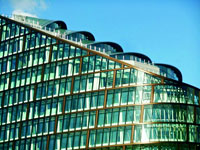
It is necessary while designing any facade system to understand as to how the heat transfer takes place through the facade materials designated. Thermal analysis allows the designer to understand the thermal movements of several components used in the system, mainly due to expansion and contraction. Further it also helps in determining the risk related to moisture. There are four methods by which heat can transfer. As defined by Straube [4] and others, and expanded on here, the following are definitions that can be applied to heat transfer.
|
 |
Conductive Heat Flow: The flow of heat through direct molecular contact, either through a single material or through multiple materials. For solid materials (and thus building materials), this is the method by which most heat flow or transfer typically occurs. For example, materials used in an exterior wall assembly that are considered to be highly conductive to heat flow can result in significant heat loss or gain through the assembly if not thermally protected, or separated, within the enclosure.
Convective Heat Flow: The flow of heat by molecules (either liquid or gas) via a change in their heat content. This method of heat flow can happen between fluids and solid elements, or strictly within fluids.
Radiation: The transfer of heat by electromagnetic waves through a gas (or vacuum), and requires a line of sight between the source and the contact surface. Since all objects above absolute zero radiate heat, the net transfer of heat is the condition that must be considered. Radiation is a relatively common mechanism for some methods of heating and cooling (radiant heating or cooling, for example), and is also a concept that must be understood to properly employ shading devices for passive heating and cooling of exterior wall systems and assemblies.
Change of State: A change of state, or phase change, from liquid to gas, or from liquid to solid, which results in a gain or loss of energy. The movement of energy can become latent heat. Changes of state occur at constant temperature.
Moisture Transfer
|
While analyzing the moisture related risks, which in principle are the largest set of problems that the structure faces during its life time, the mechanism through which the moisture transfers has to be carefully examined. Facade components that are in wet zone of the system are susceptible for storing the moisture and if proper drain out system is not planned, this leads to several issues related to ingress of water can occur. There are mainly three factors to be understood- the wetting, the retention and the drying.
Wetting-Wetting can occur as a result of direct or indirect exposure of a façade element, or elements, to bulk rainwater |
 |
penetration, as well as due to diffusive or convective vapor flow across an exterior wall system or assembly that results in condensation inside the wall system. Once wetted, capillary transfer within, or between, layers of an exterior wall assembly can also occur, and can be further exacerbated by moisture loads inherent to an exterior wall product or material shortly after initial installation.
Drying- Drying can occur by two processes: evaporation and desorption. The following will generally influence the rate of drying of an element within an exterior wall system or assembly:
Storage Capacity- Storage capacity is the ability of any material or element in an exterior wall system or assembly to safely absorb and "hold" moisture.
Moisture transfer Mechanisms
Several materials used as Building Skins will have different moisture absorbing and moisture retaining capabilities. Materials like bricks, concrete blocks, natural stones etc are known to retain high amount of moisture and repeated exposure to wet conditions may subsequently give rise to effects like ‘efflorescence’, which is not desirable. Moisture can transfer through various mechanisms and a few important ones are mentioned below.
Diffusive Vapour Flow- In this case, the moisture transfer takes place in its gaseous state through different layers of an exterior wall system. The rate and direction of diffusive vapour flow is directly dependent on following factors.
- Exterior and Interior ambient temperatures
- Relative humidity
- Vaopur pressure between interior and exterior conditions
- Individual layer permeability
Flow due to Capillary action- Capillary action can be defined as the ascension of liquids through slim tube, cylinder or permeable substance due to adhesive and cohesive forces interacting between the liquid and the surface. When intermolecular bonding of a liquid itself is substantially inferior to a substances’ surface it is interacting, capillarity occurs. When water replaces air in porous facade materials, thermal efficiency gets severely affected. The water in the capillary makes the building wet and thus, maintaining a constant internal temperature requires more heat energy. Water retention also helps accelerate decay mechanisms and ingress may lead to freeze-thaw (spalling) damage to exterior facades including microbiological growth.
Wicking - is a process by which the absorption of a liquid by a material takes place in a manner similar to candle wick and hence the name. Some facade materials absorb liquid through capillary action like paper towel, allowing a fluid to be transferred from a surface to internal matrix. This process also helps retain water making the material wet.
Gravity Flow: The flow of moisture through an enclosure after a wetting event caused by the downward force of gravity on water in its liquid state.
Advective Moisture Flow: The bulk movement of air as a mechanism for the transfer of moisture in its vapor state across an exterior wall system or assembly.
Wind-Driven Rain: The process by which rainwater is "driven", or forced, through an exterior wall system or assembly, due either to existing voids in the wall system itself, or to voids created by allowable, in-service deflection of the wall system under applied wind loads.
Facade Classification
Facades can be generally classified into the following two systems.
- The Singular System
- The Dual System.
Singular System relies on a single exterior barrier or exterior skin to prevent non desirable elements of nature including the infiltration of moisture without any complementary system. In singular system, the external skin becomes a primary barrier and any water leakage or condensation behind the exterior skin typically becomes trapped and prematurely deteriorates the system. Examples of single-stage systems are roof membranes and insulated metal panels. The Dual System includes a primary barrier with a secondary waterproofing layer. An example of a dual- system is a brick masonry wall veneered with water proofing plaster.
In any contemporary façade design, glass attains importance as one of the most preferred materials in the modern facade culture mainly due to its diversity and transparency. Traditional materials like metals, timber, concrete and stone are being developed further with new design concepts, techniques and implementation methods. In addition, high performance and new generation materials enabling with enhanced properties and capabilities are available in the market today. Some of the important façade types include: Cladding, Glazing, Ceramics, Precast Concrete, Eco friendly and Energy efficient, Security-enhancing and Dynamic Facades.
Cladding
|
Cladding can be defined as an exterior finishing system that protects the underlying structure and provides a decorative finish. Cladding as a system normally lasts long if done well and maintained regularly. It is easy to install and work with. There are many different types of cladding systems that we can choose from. Here is an overview of the most common types of cladding:
Weatherboard cladding- This is made from timber, reconstituted hardwood, fibre cement or vinyl. Weatherboards can be fixed to all kinds of substrates. Timber and fibre cement weatherboards need periodic maintenance to keep them looking their best while vinyl weatherboards are practically zero maintenance.
Timber cladding- Timber cladding is extremely popular as nothing |
 |
beats the look of real timber, and timber suits all styles of homes. Timber cladding comes in horizontal boards, shingles or panels. It is a surprisingly environmentally friendly cladding choice as sustainable timber is used and it is also a good natural insulator.
Stone cladding- Stone cladding brings a feel of natural style and elegance to your home and the look is unmatched by any other type of cladding. It uses thin layers of natural or simulated stone. Stone cladding complements any surrounding. However, stone can be expensive (simulated stone is somewhat cheaper than real stone however) and more labour intensive than other types of cladding. Natural stone cladding varies from raw cut stone to mirror polished, glossy stone to rustic looking finishes.
Vinyl cladding- Vinyl Cladding requires practically no maintenance. Vinyl cladding suits all kinds of homes and comes in a range of colours. It is also economical. Vinyl cladding is recyclable and uses fewer resources in its manufacturing than other types of cladding. It is easy to add insulation to vinyl cladding as well.
Fibre cement cladding- This type of cladding is made by compressing sand, cement, and cellular fibre into sheets. Fibre cement cladding gives the appearance of wood but it is lighter, easier to install, and requires less maintenance.
External foam cladding- This is also known as an External Insulated Finish System (EIFS) and it is made from expanded polystyrene that has been reinforced with fibreglass mesh and finished with a render. It comes in panel form, is easy to install, is extremely tough and weather resistant, and is extremely energy efficient.
Metal cladding- Metal cladding is either steel or aluminium cladding. The metal is protected through anodising, galvanising or powder coating and a range of different colours are available to suit any colour scheme. A range of looks can be created using metal cladding such as sleek flat panels or corrugated looks. Metal cladding is also very low maintenance.
Concrete cladding- This is a newer type of cladding and it comes in panel or tile form ready for use inside or outside the home. Concrete cladding can create sleek modern looks or you can have the concrete moulded to resemble natural materials such as stone. You can also cast patterns into the concrete cladding if you wish. Concrete cladding is incredibly strong and durable, and requires little in the way of maintenance. It is also a great insulator.
Modern precast concrete cladding panels sometimes with form-liners and exclusive patterns are commonly being used in many prefabricated high rise structures. They are easy to install and erect and need less maintenance.
Brick cladding- Brick cladding is great as you can create a variety of looks and patterns just by using different coloured bricks. You can also render over them if you choose. Bricks are lightweight, easy to work with, a good insulator, and don’t need much maintenance.
Aluminium cladding- This system of cladding is extremely durable, lightweight, leak proof and most commonly used in urban conditions. Enormous options in terms of features, finishes, colours, patterns to suit every condition are available in the market.
GRC or GFRC Cladding- A system of composite material comprising a mixture of hydraulic cement, silica sand, alkali resistant (AR) glass fibers and water, that can be applied to the surface.
| Monolithic Plasterboard cladding- These systems have a seamless appearance. They have become popular in recent years, but have to be designed and applied properly or they will leak. The ‘leaky home’ problem is largely to do with incorrectly constructed monolithic cladding. Ongoing maintenance is essential. The traditional monolithic system is stucco. Cement-based plaster is applied over a variety of backings including fibre-cement and plywood sheeting. It is then painted. This is the oldest of the three types of monolithic cladding and has been used in New Zealand since the 1920s. Exterior Insulation and Finish Systems (EIFS) are multi-layered systems, using polystyrene insulation and |
 |
reinforced plaster. There are several different proprietary systems available. Fibre cement sheets can also be plastered to give a monolithic effect. All monolithic claddings rely on the final coat for waterproofing, and this needs to be well maintained.
Plaster- Plastering as an exterior cladding provides a clean and seamless appearance providing an attractive aesthetic to most construction types. It allows for virtually unlimited colour selection, and textural style. Plaster Claddings are applied over a 'rain screen, drainage' cavity, as with the majority of external claddings today, allowing incidental moisture to drain away, in a similar way that brick veneer, and weatherboard cladding does.
Substrates- There are many different substrates to which plaster can applied the most common include; Brick veneer, solid filled concrete block (new or existing), EIFS (polystyrene), AAC (lightweight masonry panel), fibre cement sheet. All exterior plastering, as with timber weatherboard requires maintenance in the form of cleaning and re-painting.
Other types of facades are covered in subsequent sections
References:
1. Architect Swetha’s article in Built Expressions, November, 2012 issue
2: Courtesy: Thornton Tomasetti
3: Courtesy: home improvement pages
http://lowerenergyfacades.lbl.gov ; http://wbdg.org ; www.steelconstruction.info