Case Studies on Failures Due To Earth Quake, Wind, Fire, Soil and Blast
Techno-Legal Assessment for Claims
Er. P Surya Prakash, MD, Satyavani Projects and Consultants Pvt. Ltd.
Introduction
Forensic Civil Engineering is emerging specialization in India after allowing FDI in Insurance and Opening up for Private players. The need for Injuries forensic investigation arises out of two reasons.
-
Legal accountability for and/or Death of Life, Damage to Facilities, Which will be cause for legal conflict.
-
Insurance claims for loss compensation leading to again legal settlement.
Both reasons call for logical and legally binding investigations to identify the actual cause of failure/damage. The agency/individuals are Owner/Developer, Consultants - Architect/ Consulting engineer/ Structural Engineer/ Project Manager/ Supervising Engineer/ Geotechnical Consultant, Builder/ Contractor and/ or their engineer, End user/ Occupant/ Lessee. The investigator shall conduct failure assessment to find cause of failure to fix the accountability which shall stand the test of legal examination. The investigation shall be based on well founded legal processes and documented for standing as evidence.
Cause of Failure
- Mismatch between Construction Intent and Actual Condition
- Loading, Soil, Accident, Material, Construction Method, Structural System, Corrosion, expected life
- General Loads : Seismic, Wind, Dead, Live
- Soil : Settlements, Liquefaction, Expansive, Caving
- Accident : Fire, Blast, Impact, Flood
- Material : Poor quality, Wrong specification, shelf life
- Structural System
- Corrosion and Life of Structure
Investigation
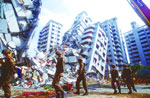 |
The first step after the failure is to call for investigation without disturbing the damaged site except for any rescue operations. The Terms of Reference (TOR) to the investigator shall be complete to establish the cause of failure and sequence of failure to establish actual cause of damage, injury or death. There shall be registry of the eligible investigators, apart from loss assessors, Police and legal commissions.
|
The causes are explained in a sequential manner and explained in this section.Mismatch between Construction Intent and Actual Condition
Generally if the cause of failure is anything beyond the construction intent defined/accepted by the developer/ owner the responsibility of the consultant ceases to exist. However this shall be established with thorough investigation and documentation.
Loading
Designed loading is very important for life of any structure. The design intent provided by structural consultant will define the loads considered for design based on the construction intent provided by the client such as Occupancy, location, materials to be used etc. This activity is coordinated by Project Management Consultant/ Owners Engineer.
General Loads
Seismic
The possibility of load exceeding is high in seismic conditions. However the design and detailing provisions are extensively available for seismic resistant design. Most of the failures reported are due to improper structural system or insufficient design or poor material quality.
Wind
The wind is similar to seismic conditions. But the probability of load incidence is also high. Many failures happen during the months of March and April. Failures are reported due to hail storms or due to combination of temperature drop and wind accelerogram mismatch with assumed one. Most of the failures reported are due to improper structural system or insufficient design or poor material quality.
Dead Loads
The possibility of failure due to dead load occurring is vey minimum. But many such failures are reported during construction phase.
Live Loads
Generally live load exceeding design load is almost negligible. Failure due to live loads occur in large silos, large span structures and industrial floors.
Soil
Geo Technical investigation and design is next important basis for performance of the structure. Structural consultant shall draft the requirements of investigation depending on type of structure the depth and extent of investigation is defined. The investigation is carried out and recommendations about type of foundation are defined by the Geo technical consultant.
Settlements
The soil settlements are very complex to predict and calculate. As the soil behavior is not based on structure designed in one location. The influence of neighboring structures also can affect the settlements. The soil settlements are highly sensitive to moisture conditions which in turn are difficult to envisage.
Liquefaction
Though it’s very difficult to assess the condition, emerging technologies offer good solutions to tide over this phenomenon. This condition occurs mostly during slope failures, earth quakes etc.
Expansive
Expansive soils or swelling clays affect structures very intensively if the phenomenon is not understood during investigation. These soils require special treatment and foundation design.
Accident
Apart from the well defined loads, during the life span of structure it may be subjected to accidental loads such as fire, blast, flood etc. For some structures these may be considered in design when the construction intent defines the imminent threat eg., defense establishments.
Fire
Fire is an abnormal accidental load for which total resistance to failure is difficult. But the minimum fire rating as stipulated shall be followed while designing the structures. The fire rating is only to minimize the loss of life but may not save structure from collapse.
Blast
There are blast resistant structures designed when it is envisaged in construction intent. Accidental blast is difficult to design for.
Material
The specification of material viz., Grade, type, make etc., QA plan, QC requirements are defined in technical specification of the execution document. The responsibility of conformance rests with the Project Manager/ Supervising Engineer. The same shall be confirmed by the structural engineer though the primary responsibility is with the executing agency.
Poor quality
The quality of materials plays very important role in safety of structures. Many of failures are reported because of poor quality materials.
Wrong Specification
There are failures reported due to mismatch in spec considered and actually provided.
Shelf Life
Sometimes the materials with limited shelf life are used after the expiry of shelf life.
Construction Method
The method of construction shall be submitted by executing agency for approval by the structural consultant as any incidental loads/ stresses during construction stage shall be checked and satisfied by the structural
engineer. Construction engineering drawings shall be submitted by the execution agency for approval by structural consultant.
Structural System
The structural system considered in the Analysis model, Design, Detailing and the actual execution shall be conformed to and the structural consultant and the supervising engineer shall be responsible for it.
Corrosion
The climatic conditions, weather conditions and operating conditions of the facility shall be well defined in the construction intent. This is more particularly applicable for steel structures.
Expected Life
Every structure/facility has design life subject to certain preventive maintenance guidelines. Also life of such structure may be extended subjected to certain tests and retrofitting.
Case Studies
The author had experience in assessing the causes of failures in many categories of failures and represented for Legal claims, enactment of codes, funding to governments, Insurance claims.
-
Gujarat Bhuj Earth quake urban damage assessment for categorization of damage.Failure of many Microwave towers and Transmission Line towers.
-
AP Hazard Mitigation and Emergency Cyclone reconstruction project.
-
Fire accidents and damage to buildings.
-
Gas cylinder blast.
-
Residential Township constructed in expansive clays.
-
Dilapidated heritage building.
-
Grains silo
These case studies being voluminous are presented in Lecture and softcopy.
Techno-Legal Assessment for Claim
The documents to be assessed are:
-
Construction Intent or Functional Requirement Document.
-
Consultants agreements with the developer
-
Architect
-
C & S Consultant
-
MEP&HVAC Consultant
-
Geotech consultant
-
Independent Engineer
-
Review Consultant
-
Contract document
-
Site Quality registers
-
FIR from Police
-
Occupancy certificate/ Handing over document
-
Tests on material samples collected at site
-
Photographs of failure site
-
Failures in the vicinity in case of Earth quake, wind, Settlements, flood, fire, blast etc.,
-
Meteorological reports
-
News paper reports
-
Any other document felt required specific to case.
-
After the study and assessment of the documents and analysis carried out to identify the actual cause of failure the assessor shall generate a Forensic report which shall form the base document for any legal judgment and/ or claim.
Conclusion
The accountability to be fixed on Professionals need of the hour is Engineers Bill. Rationalization of procurement norms, Mandatory norms to have signatures of four categories of engineers for occupancy certificate of any structure viz., Structural Engineer, Geo-Tech consultant, Proof Consultant and supervising Engineer to first eliminate or reduce freakish failures. Also mandate on periodic maintenance checks and certification for fit to continue to occupy.
About the Author
 |
Mr. Suryaprakash is presently President (2013-2015) of the Association of Consulting Civil Engineers (India). He is also Founder Director of M/s Satyavani Projects and Consultants Pvt. Ltd and M/s Satyavani Homes Pvt. Ltd. He has over 30 years experience as a Structural Engineering consultant and has completed a large number of prestigious building projects in India and abroad.He has developed special expertise in the design of transmission and communication towers and is the author of a book- "Design and Implementation of Communication Towers". He has also delivered several lectures and presentations in this area and organised the Tower Convention 2002 for Cellular and Basic Operator, and compiled the Tower Manual. |
He was Organising Secretary of the World of Innovations in Structural Engineering Conference in 2004 and Engineering in Architecture in 2003. Mr. Suryaprakash was a Member of the Expert Committee for Categorisation of Seismic Damaged Structures in Gujarat.
He can be contacted : svpcpl@gmail.com