Khan Shatyr- The Translucent Marvel
World’s biggest tensile structure
Khan Shatyr (Royal Marquee') Entertainment Centre in Astana, the capital of Kazakhstan
is significant in terms of architecture and magnificent in size. Yes, it is termed
as the largest tent in the world measuring 150 m tall with a 200 m radius and 1lakh
sq. m contained within the translucent canopy.
Underneath the tent, an area larger than 10 football stadiums is an urban-scale
internal park, shopping and entertainment venue with squares and cobbled streets,
a boating river, shopping centre, mini golf and indoor beach resort. The tent was
designed by UK-based architect firm, Foster + Partners’ second in Astana,
as the firm designed the iconic Palace of Peace previously. Behind the beauty and
engineering part of Khan Shatyr was the extreme climate challenge that Astana posed
as the given that temperature can drop to -35 degrees Celsius in winter and climb
as high as +35 degrees in summer. It was the three-layer ETFE envelope came in handy
to iron out the weather challenge. The fabric roof is constructed from ETFE-cushions
provided by Vector Foiltec suspended on a network of cables strung from a central
spire.
|
Work began on site in 2006, with the driving into the ground of the huge bored piles
that would take the tripod’s bases. The steel sections for the tripod were
prefabricated in Turkey and transported to the site, where it took four cranes to
erect the 2,000-tonne structure during two weeks. The work was timed to avoid the
worst of the high winds that often occur in winter. The prefabricated foil cushions
have been made in China. They have been numbered and labeled to be transported to
the site by train. The ETFE cushion panels are connected to the cables using a system
of aluminium clamping plates. These are able to tolerate the movements of the cables
under wind and snow loads. The cable net comprises 192 radial cables and 16 circumferential
cables. To improve handling, cable diameters were kept below 76mm, while to provide
strength, cables are generally installed in pairs, which
|

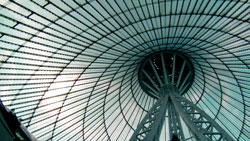 |
also facilitates the clamping between radial and circumferential cables.
With the tendency of temperature swinging between winter and summer, keeping the
building at a comfortable temperature was always going to be a challenge. For example,
in the winter the surface of the ETFE cladding is very cold. This means warm air
that hits the cold surface immediately cools and drops down, creating a wind inside
the building. This was one of the reasons why the team decided to restrict the height
of the ETFE-clad part of the building. Warm air is also directed against the surface
of the ETFE to ameliorate the problem and stop ice forming on the surface.
There was also a risk of condensation caused by water evaporating from the high
level sea-cum-swimming-pools at the top of the building when it met the cold surface.
The answer was to enclose the pool areas inside a secondary ETFE clad space. Since
ETFE is a good insulator, it helped to harness solar gain. Obviously the building
needed to be heated in the winter and cooled in the summer. This is done fairly
conventionally by pulling air from outside, heating or cooling it and directing
the conditioned air into the lower inhabited spaces, and out again at low level.
Air can be directed out of the top of the tent if it gets really hot inside. Energy
use is mitigated by being generous with internal temperature tolerances.
In order to avoid formation of ice on the inside of the envelope, a combination
of temperature control and directing warm air currents were used. In summer, fritting
on the outermost foil layer provides solar shading and from inside, low-level jets
direct cool air across the space.
The transparency and scale of the tent stands out in the skyline like a beacon,
changing colors at night and streaming in natural light during the day. The stunning
attraction of Khan Shatyr is its indoor beach, which is located on the top level.
It boasts of waterslides, spas, beach volleyball courts and a pool. The sand was
flown in from the Maldives and is as white as the sands on tropical islands around
the world. Also it is a high-level shopping and entertainment center with shopping
facility, cuisine, a state of the art movie theatre and an amusement park.
Sections through the Khan Shatyr
1. Entrance
2. Retail
3. Entertainment
4. Beach Area
5. Tripod
6. Ring support struts
7. Cable support ring
8. Cable net/ETTE cladding
9. Car parking
Facts
Location: Astana, Kazakhstan
Construction started: December 2006
Completed: July 2010
Opening: July 2010
Cost: US$400,000,000
Owner: Sembol Construction
Technical details
Roof Height: 150 m (490 ft)
Floor area: 100,000 m2 (1,100,000 sq ft)
Design and construction
Architect: Foster and Partners
Engineer: Vector Foiltec (climate shell)
Structural engineer: Buro Happold