New-fashioned Parking Structure#6
City of Santa Monica Parking Structure #6
Parking infrastructure in developed countries is taking a professional approach. While designing a space for parking vehicles, overseas countries are considering design, it's scale and environmental impacts too. As a testimony, the City of Santa Monica boasts of a parking structure that gives a visual treat and apt functionalities of parking space it is known as Parking Structure #6 in downtown Santa Monica that also serves as a major local and tourist destinations.
The structure #6
The City of Santa Monica Parking Structure #6 is designed by Moore Ruble Yudell Architects & Planners. Along with 900 spaces for traditional cars, the garage reserves 14 spots for electric vehicles and storage for bicycles is its unique feature. The structure must be appreciated for its well planned design. The features holistic elements of green building including sustainable building materials, photovoltaic roof shade canopies which provide all of the building’s energy, storm drain water treatment and high efficiency mechanical systems.
“Parking structures are sometimes scary after dark but not this one. One night, as I drove by on yet another of my night time inspections, I spotted two tourists photographing each other at the building. That’s when I knew the team had done our job”, says James Mary O’Connor, AIA, Principal-in-Charge of Moore Ruble Yudell Architects & Planners.
Dazzling Pattern
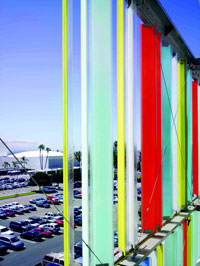
All facades allow natural ventilation and illumination to enter all parking floors. The ceilings are painted white to maximize the quality of light and airiness. Multicolored glass panels welcome day-light into the structure and decreases the amount of artificial light that is generally needed for this type of building while adding a glow of beauty to the interior and a luminous exterior by night. Colorful glass panels decorate the exterior and sculptures structure serve as aesthetic landmarks. The colored vertical strips total 7,000 square feet of custom-painted, Prisma solar texture LINIT channel glass planks supplied by Bendheim Wall Systems and manufactured by Lamberts in Germany.
The facade light enhancement screen which is carefully crafted to bring light deep into the building structure while eliminating harsh glare at the edge. The screen is composed of metal panels are folded outwards to catch and redirect high angle sunlight into the depths of the structure. The portion remains unfolded and it is perforated to allow for the passage of low angle light directly into the garage and to provide a high degree of visual transparency. This combination allows for a greater amount of light to enter the garage over a longer period. The facade not only provides a functional lighting aspect for the parking structure. It also creates a strong identity enlivening the streetscape.
Colourful Elements
The design does not disguise the utilitarian nature of the building but instead seeks to celebrate this aspect as part of the design aesthetic. Automobiles from their colors, types and movement are integrated as elements in the overall design strategy. The design solution uses colored laminated glass channels, photovoltaic panels, ribbed precast concrete panels and steel mesh to render a unique civic presence. First off it pops with red, orange and yellow metal panels each set at a different angle to reflect light in a way that illuminates the interior. The panel’s colors are intended not merely to look sunny but to correspond metaphorically with changing illumination levels on the facade.
The point of the stair while standing at the top of it (right) is to ‘vertically continue the sidewalk’, integrating the structure with the pedestrian experience gives a civic presence and making it part of a multi-model approach to mobility in Santa Monica.
The building provides a memorable arrival point to the Civic Center. By the bright rainbow of glass panels made with Vanceva producing a broad spectrum of colors and moods are unachievable using stock selections of glass. Vanceva color by Saflex gives architects and designers more creative freedom to play with glass. The colour technology welcomes daylight into the structure reduces the need for artificial lighting while creating a light and airy space. At night the panels transform the building into a luminous exterior display of softly glowing light and color. The fresh innovative use of color in the design reflects the purpose of the building itself; the many colors, patterns, and sizes of the glass panels echo the colourful diversity of the automobiles of the automobiles inside.
Flexible Parking Solutions
HUB Parking Technology, a parking systems solution provider has offered an integration with the fare collection system for Santa Monica city buses called Big Blue Buses. Customers will be able to pay for their parking and take the city bus with the same value card and easily add credit on fare cards using our DATAPARK Pay Station. It will improve convenience and enable fast transit flow by providing passengers with a variety of means to pay fares. The City of Santa Monica will be promoting increased public transit use by providing privileges to ride more on the bus and drive less. For example: take the bus 10 times, get one day of free parking within 30 days. Therefore the new solution will be able to track usage on both bus ridership and parking usage.
HUB Parking Technology delivers the flexibility, professional expertise and close personal service of a local company together with all the capabilities, network and strength of a global player. Over the years, the company has constantly innovated to develop state of the art systems that make parking efficient for users as well as profitable and easy to manage for operators. HUB Parking Technology has remained keenly focused on enhancing its latest technology differentiation, delivering integrated and value added solutions.
Features
The garage has 882 parking spaces accommodated in six levels above grade and one-half below grade. It also includes reserved spaces for public safety vehicles, bicycles and electric vehicle charging stations. The building includes a restaurant on the second level and ground level office space.
One of the challenges for this project is to create architecture out of a common building type. One that is not generally associated with high design standards. “The design addresses this standard service amenity by viewing it from a fresh perspective and taking it to a higher level where it can have a positive influence on its surroundings. Primarily, the building provides 900 parking spaces. In addition, the structure off ers a visually memorable arrival point and gateway to the new Civic Center, street-level retail and café amenities, spectacular views of the Pacific Ocean and the city, a garden, and a sense of personal safety”, said O’Connor, recipient of the American Institute of Architects (AIA).
Energy savior
 |
213 kW DC photovoltaic panels are installed on the roof to provide electricity for internal usage. The building uses natural light and efficient fluorescent lighting that reflects off white ceilings to enable lower total lamp wattage for effective lighting and to minimize light spill to unwanted places. The Solar power inverter converts direct current generated from the photovoltaic panels into alternating current for use in the facility. Rooftop photovoltaic panels generate electricity for the facility uses. The panels also provide some shade for cars parked on the top level. Reclaimed water lines for landscaping and tenant space toilets reduce the demand for potable water. Storm water Management Runoff water is treated using an on-site filtration device to reduce total suspended solids and phosphorus before it enters municipal waste water collection system. |
- Concrete contains locally mined aggregate and recycled flyash.
- Structural steel contains up to 68% post-industrial recycled content.
- Recycled glass material.
Bicycle storage lockers area is provided for free to the public to encourage alternate transportation modes. Electrical outlets are provided for 14 public electric vehicle parking spaces. Materials with a high recycled content used including fly ash replacement for cement and recycled content reinforcing steel and framing.
An Urban Solution
The parking problem had become a major problem and nobody took initiative with the idea of parking system. The government allowed varied amenities incorporated into the parking structure allow the designed mass to function beyond its service capacity. The four sides of the building acknowledge the individual urban context serving as a fully designed urban presence. Small commercial spaces at the pedestrian level expand the building’s civic edge creating a destination as well as a gateway. A lively cafe on the main plaza terrace animates the pedestrian flow the heart of the Civic Center. The urban plaza and commissioned art works as highlighted both the inside and the outside of the structure of the building making it more hospitable to the community than to an ordinary parking structure.
Safety and Security
The architecture as not concentrated on the structural design in allotting parking space but also to safety and security measures. The building incorporates several features comfort, safety and security for users. Parking is organized in eight floors accessed via a centralized circulation spine. The elevator core and stairs are positioned with respect to the two major pedestrian paths in the Civic Center campus. Access and exits have been consolidated at two corners of the building serve as a control point to efficiently channel both pedestrian and vehicular traffic towards destination points. The reflective surface of the facade can be illuminated after sunset to glow as a shimmering curtain providing defensible space through a pleasing ambient light.
Fact Sheet:
Project: City of Santa Monica
Design Architect: Moore Ruble Yudell Architects & Planners.
Executive Architect: International Parking Design (Don Marks, AIA, Dirmali Botejue)
General Contractor: ARB, Inc.
Landscape Architect: Melendrez Design Partners
Lighting Consultant: Francis Krahe & Associates
Artist: Mark Lere
Pre-cast contractor: Willis Construction Co. Inc.
Structural Consultant: Frame Design Group
Curtain Wall Installer: Woodbridge Glass Inc.
Curtain Wall Engineer: Werner Systems,
U-Glass Panels Bendheim (manufacturer), Specialty Glazing Systems (distributor)
Colors on Glass Panels: Grosvenor Solutions in Glass
Photovoltaic Panels: RWE Schott Solar Inc.
[http://www.archnewsnow.com/features/Feature236.htm]
Reference