The Dazzling Opera, Paris (Palais Garnier)
Epitome of grace and beauty
In the Western part of the world, subtle entertainment is one of the important aspects of their daily life. Most cities in the Western parts are famous for entertainment oriented programs and are destinations of artistic significance and eloquence. Opera is one among the art forms of entertainment very well acclaimed in the western countries. This is an art form in which a dramatic work is performed by the singers and musicians with the background music score by a small orchestra. The Opera house is one such destination for these artistic entertainments and it is a part of the Western classical music tradition.
The Palais Garnier also known as the Opera de Paris or Opéra Garnier, but more commonly as the Paris Opera, is one of the worlds largest and famous opera houses, known for its opulent design and is still considered as one of the masterpieces of the period. The construction of this massive structure lasted for about 14 years, from 1862-1875 and the mastermind for its excellent design was architect Charles Garnier. The Opera National de Paris has a total area of 11,000 square meters (118,404 square feet) and a vast stage with room for up to 450 artists. The auditorium itself comprises roughly half of the total space, most of the rest being used to house necessary logistical support so that the stage demands of any opera can be met.
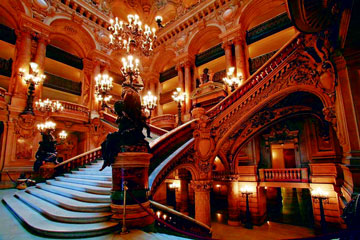 |
The structure's style is a monumental one, classically approached and opulently expressed through the colorful marbles, carvings on the façade, winged figures and embellishments. This richness continues in the interiors of the opera house with velvet, gold leaf, and nymphs and cherubs. The auditorium's central chandelier weighs over six tons, and its ceiling was painted in 1964 by Chagall. Upon its inauguration during 1875, the opera house was named officially the Academie Nationale de Musique Theatre de l'Opera. It retained this title until 1978 when it was re-named the Theatre National de l'Opera de Paris. After the opera company chose the Opéra Bastille as their principal theatre upon its completion during 1989, the theatre was re-named as the Palais Garnier, though Académie Nationale de Musique is still sprawled above the columns of its front facade. In spite of the change of names and the Opera company's relocation to the Opera Bastille, the Palais Garnier is still known by many people as the Paris Opera, as have all of the several theatres which have served as the principal venues of the Parisian Opera and Ballet since its initiation.
History
 |
The initiative was taken by Emperor Napoleon III as part of the great construction of Paris during the Second Empire, who chose Baron Haussmann to supervise the reconstruction. During 1858 the Emperor authorized Haussmann to clear the required 12000 square meters (1.2 ha) of land to build a second theatre for the world-renowned Parisian Opera and Ballet companies. |
The architect was selected by conducting an architectural design competition in the year 1861. Charles Garnier won the competition to design the Palais Garnier. The foundation stone was laid during 1861, with the start of construction during 1862. According to the history, Emperor's wife, the Empress Eugenie, asked Garnier during the construction whether the building would be built in the Greek or Roman style, to which he replied: "It is in the Napoleon III style, Madame!"
Opera's Design
Since it was an opera house, Garnier decided to approach it from an artistic point of view and to make it very much flamboyant in its appearance. He believed that the opera is an expression of humankind's primitive instincts, share thought and to foresee things through the structure. The theater design for the opera was drawn from the rapid evolution of the Italian Renaissance. In the progress of design and research some of the Roman theater semicircular designs were taken into consideration but Garnier came up with a shape similar to U. And he appeared with an exceptional design of Napoleon III style, the structure was decorated with carvings and winged statues etc.
The basic plan of the Opéra is both simple and sensible, with excellent proportions. It consists of two clearly defined, easily accessible and practical sections: a forward section of public spaces and a rear section of theater spaces. In designing and decorating the various areas, Garnier ingeniously considered the activities, gender and station of persons within the area. The public space, designed to facilitate the natural progression of people through the building, is subdivided into several principal sections: the Grand Vestibule, which received people from both the pedestrian and carriage entrances (with a separate entrance for the Emperor); a flight of steps leads to the smaller Vestibule de Contrôle, where tickets were taken; from there you enter the huge Grand Staircase, which ushered everyone upward toward the Auditorium, and surrounded by a wide corridor.
During intermission, people could mingle in the Forward Foyer and the Grand Foyer, which is flanked by two Octagonal Salons and Small Salons; go out into the Facade Loggia for fresh air, the Fumoir to smoke or the Glacier for refreshments. The theater space is subdivided into the stage and posterior administration sections. The building occupies a roughly diamond-shaped plaza at the end of the Avenue de l’Opéra and is designed so effectively that it looks as if it, the streets and the square were created in harmony by one architect.
Architecture & Style
The Palais is decorated opulently with elaborate multicolored marble friezes, columns, and lavish statuary, many of which portray deities of Greek mythology. Garnier designed the exterior of the Opera as lavishly as the interior. The entrance for the Emperor, on the south side, was flanked with splendid caryatids by Elias Robert and crowned with a magnificent, royal eagle. Twenty-two female figures in bronze by Louis-Felix Chabaud adorn the perimeter balustrade. They hold aloft lamps representing in alternation the morning and evening stars.
The Opera's sculpture is of two kinds: ornamental, the almost immeasurable amount of bands, brackets, capitals, cartouches, consol's, corbels, cornices, festoons, friezes, keystones, mouldings, pilasters, soffits and so forth that adorn the walls and ceilings; and statuary either free standing or some form of bas or high-relief (there are, for example, 68 portrait busts on display in the Opera’s public spaces). Garnier's control over the ornamental sculptors was complete. They executed models and final products after his precise designs.
The interior consists of interweaving corridors, stairwells, alcoves and landings allowing the movement of large numbers of people and space for socializing during intermission. Rich with velvet, gold leaf, and cherubim and nymphs, the interior is characteristic of Baroque sumptuousness. The ceiling area, which surrounds the chandelier, was given a new painting during 1964 by Marc Chagall. This painting was controversial, with many people feeling Chagall's work clashed with the style of the rest of the theater.
Sculpture and Decorations
The shapes made by the free standing sculptural groups enhance and animate the buildings outside contour. The interior of the facade is enlivened by the outside shapes and the patterns created by light and shadow on the bas-reliefs of the upper and lower sections. Gilded busts of seven important composers fill the oculii above the loggia balcony openings and bas-reliefs depicting Architecture and Industry by Jean-Claude Petit and Painting and Sculpture by Theodore-Charles Gruyere adorn the pediments above the outer bays. The perimeter of the attic summit is decorated with smiling and frowning gilded grotesque masks. On the frieze below, above the two large columns between the loggias openings are four groups of high-relief figures by Jacques-Leonard Maillet. Separating them, above the loggia oculii, are five roundels with figures on each side.
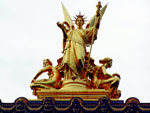
On the left and right side of the facade attic are two corresponding groups representing Harmony and Poetry by Charles-Alphonse-Achille Gumery. These groups, consisting of a main figure and two smaller Fames, were gilded during the recent restoration and they make splendid, scintillating shapes against the blue of the sky and the newly cleaned white stone of the facade. When viewed from the front, at a proper distance, one may see the fly tower above the Opera’s stage rising behind the Auditorium dome. On the two corners are magnificent bronze sculptures of Fame Holding Pegasus by the Bridle by Eugene-Louis Lequesne. At the apex of the fly tower is a group of three figures by Aime Millet, Apollo, Poetry and Music. On the four arcade piers between the five central arches are single figures representing various forms of music (The Idyll, The Cantata, The Song and Drama). Above them are relief medallions containing the profile of four great composers. The combination of architecture (white, colored stone and various marbles) and sculpture (gilded, partially gilt, stone and bronze) forms a unified, harmonious and picturesque effect.
The Auditorium
The Opera's Auditorium seats about 2,000 people. Four tiers of balconies surround the ground floor, culminating in elaborate forward boxes to the left and right of the stage, with their sculptured caryatids by Gustave-Adolphe-Desire Crauk and Alfred Édouard Lepere. The coloration is muted gold, set off by the red theater boxes and seats with an occasional balancing accent of muted green on the cartouches decorating the front of the loges. Garnier intended the color of the Auditorium to tastefully set off the dress and appearance of fashionable ladies and to prepare the audience for the performance, putting them in a proper mood for the music and dance to follow. The large, circular painting on the ceiling provided a decorative canopy over the lavish, guilded architecture and ornament of the Auditorium.
Set backs
The architect came across numerous challenges when the project commenced, one is the swampy ground water which obstructed the laying of the foundation. Below the ground flowed the subterranean lake, therefore it was essential to remove the water and took eight months of continual pumping. Other challenge was the Franco Prussian war which halted the construction as Paris was under siege and funds were not generated on time. After the defeat of France Garnier fell ill and the construction came to a standstill and he moved to the Ligurian Coast of Italy for recovery. Subsequently at the same time the second French Empire came to an end along with the Paris Commune. During this period of time construction was at snail’s pace and there were some rumors about abandoning the Opera project too.
The impressive appearance of the structure showcases the extreme work made by the architect. The architect’s work is portrayed by its very own glorious design and the exclusive decorations on it. In terms of design the structure is an amazing masterpiece in the artistic point of view. Thus the structure is a dazzling jewel which has added glory to the capital city of France.
Reference:
The Book of Architectura by Professor Miles Lewis
QUOTES
The architect's work is portrayed by its very own glorious design and the exclusive decorations on it. In terms of design the structure is an amazing masterpiece in the artistic point of view. Thus the structure is a dazzling jewel which has added glory to the capital city of France.
Four tiers of balconies surround the ground floor, culminating in elaborate forward boxes to the left and right of the stage, with their sculptured caryatids by Gustave-Adolphe-Désiré Crauk and Alfred Edouard Lepère.
The Palais is decorated opulently with elaborate multicolored marble friezes, columns, and lavish statuary, many of which portray deities of Greek mythology. Garnier designed the exterior of the Opéra as lavishly as the interior.
The structure's style is a monumental one, classically approached and opulently expressed through the colorful marbles, carvings on the façade, winged figures and embellishments. This richness continues in the interiors of the opera house with velvet, gold leaf, and nymphs and cherubs.