Concrete Wharf of Hobart
Brooke Street Pier, Tasmania
It is both a building and a boat--the new Brooke Street Pier is a four storey floating pier, a pontoon building at Sullivans Cove in the waterfront area of the city of Hobart, Tasmania, Australia. It was constructed in 2014-15 at a cost of A$13 million. It weighs 5,300 tonnes and is Australia's largest floating building. It is connected to the Hobart shore at Franklin Wharf, near the base of Brooke Street.
Primarily a ferry terminal, the architect has described it as a "tourism transport hub". In recognition that the facilities at Brooke Street Pier did not meet further needs, it required redevelopment to accommodate anticipated future growth in the ferry and local cruise market, the Australian Government committed $5 million to the redevelopment of public infrastructure at the pier.
The need to redevelop the pier was also recognised in Tasmania's Infrastructure Australia submission as Hobart, a world-class, liveable waterfront city. In 2012, a consortium of local ferry and cruise operators was granted planning approval to redevelop Brooke Street Pier. The proposal included ticketing and office space to service ferry and cruise operations, cafés/restaurants and other associated facilities, all of which would be funded privately.
A business case was also completed to inform decisions about the public infrastructure aspects of the proposal, including the 80-metre floating, concrete pontoon and services infrastructure for water, electricity and sewerage.
Floating Structure
The Brooke St Pier is a very innovative structure, one that is both a building and a boat; an 80m long, 20m wide floating concrete pontoon, on which is constructed 3 floors of lightweight superstructure, all of which is now Hobart's new ferry terminal.
The project represents a significant advance in creating a practical solution to building out over the water, and indeed, on the water, as this structure does not need to be connected to the land at all. The fundamental characteristic it shares with all maritime structures is that it floats, all 4,300 tonnes of it, and like a boat, it is completely self-sufficient in so far as it carries on board all the services and systems it needs to provide a habitable environment for those using it. By building a 4m deep floating concrete pontoon instead of hundreds of piers, considerable economies could be made over a traditional wharf, quite apart from creating a useful basement.
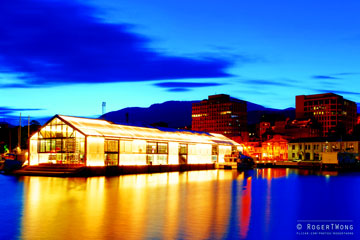
The pier behaves like a boat, with the superstructure being kept as light as possible so that the structure's centre of gravity is below the waterline. The structure also rises and falls with the tide, so it is anchored to the seabed with triangulated stretching 'bungee' cables that change their angle of thrust with the changing tide heights. The cladding of the ferry pier is made of lightweight polycarbonate ribs injected with insulating nanogel, creating a diaphanous skin, which visually compliments the significant environmentally sustainable engineering services within it - the pier 'floats on concrete and runs on water'! And the skin lights up at night….an antipodean Brighton pier!
This project is the purest expression of a wide-ranging successful collaboration between architects, engineers, builders and extremely passionate and perceptive clients, who challenged everyone in the most positive ways.
With the pier, virtually one complete floor level is given over to a large local produce and product market, with two informal cafes in addition to an up-market bar and offices. The boarding level can become a function space for up to 1200 people outside the times when it is used by alighting ferry passengers. These multifaceted uses will bring diverse activities and give vitality to the building / boat every day and night, throughout all seasons.
History of Book Street Pier
Brooke Street Pier has existed in various forms for over 150 years. Records of original pier and wharf structures can be found as far back as the 1820's. The original ferry terminal was at Waterman's Dock, located just to the west of Brooke Street Pier, which has since grown into Murray Street Pier. The current pier structure dates back to the 1960's.
|
|
|
With the pier virtually one complete floor level is given Over to a large local produce and product market
|
Pier Needed Makeover
As the Pier needed to redevelop, the aim was to recreate the former Brooke Street Pier with a modern innovative interpretation - using the maritime heritage and architecture of the precinct to deliver a new, vibrant working cruise/ferry centre.
There was an urgent need for enhanced facilities to service the rapidly growing businesses providing water based commuter and tourism services for example, those to MONA and Peppermint Bay. The proposed facility envisaged and catered for the growth of water born commuter services on the Derwent. Work on the pier commenced early in 2014 at Incat, north of Hobart, and the structure was floated into place at the Hobart dock on Sunday, 9 November.
The lightweight translucent/ transparent skin of the upper building acts like a conservatory in creating a passively heated indoor environment, which is augmented by hydronic heating cooling systems utilising the constant water temperatures under the pier itself.
The Pier creates a new waterside space for the people of Hobart and for visitors from beyond recreating a former pier as a new tourism transport hub, providing upgraded facilities for ferry users and operators and a much enhanced public facility for the community to enjoy. A new pedestrian friendly forecourt - closed off to most vehicle traffic - is a welcome addition the project. This has become a major step forward in creating a more urbane waterfront for Hobart.
New Waterside Precinct for the City of Hobart
When the concept was proposed it was to create a new waterside space for the people of Hobart and for visitors from beyond - recreating a former pier as a new tourism transport hub, providing upgraded facilities for ferry users and operators and a much enhanced public facility for the community to enjoy.
The renovation recreated the former Brooke Street Pier with a modern innovative interpretation - using the maritime heritage and architecture of the precinct to deliver a new, vibrant working Cruise/Ferry centre. The aim was to deliver a visitor experience that enhances the interface between land and water operations. It provides new waterside access and commercial facilities for our community and visitors alike.
The Hobart Ferry Terminal
The ferry boat terminal became an independent, visually separate and easily identifiable waterfront facility which conforms to recent guidelines for new freestanding structures on the waterfront. The new terminal is now built as a standalone structure for the purpose of creating a single point of embarkation for the users of all cruise boats and other associated waterborne traffic that ply Hobart waterways. It will provide a much-enhanced public and visitor facility that responds to current passenger and visitor throughput and caters for planned and envisaged growth.
Facilities at the terminal
Entry Level (First Floor)
- An Entry Ramp leading up from a wharf side central embarkation area
- An enclosed entry lobby displaying tourist information with a central check in ticketing counter area for all ferries
- Escalator and lift down to boat embarkation deck
- Disembarking points(2) for all two level boats from upper level.
- Public toilets
- Several cafés with internal and external al fresco dining facilities
Lower Level (Ground Floor)
- Mooring of all ferries with open passenger waiting areas and storage facilities
- Lobby, lift, escalator and stairs down from main Entry Level
- Toilets
- Mooring Lock-up facilities to provide security for boats on an out of hours basis
Mezzanine Level (Second Floor)
- Lobby, lift and stairs up from main Entry Level
- Open offices
- Toilets
- Upper level of rear restaurant
The Architecture of the Wharf Structures
The form of all the earlier wharf structures was broadly consistent. They always long, slender gable roofed buildings. Only the larger wharf structures had central clerestory skylights, but essentially there was a consistency in the repetitive gable roofed forms of the early wharf buildings that collectively all formed the overall visual character of the Hobart waterfront in the middle of the 20th century.
Maintenance
Design allows for restricted small service vehicle access (golf buggies with rear luggage trays) to access up the ramp and down to the ground level of the pier by the large central lift. This will effectively provide all provisioning and servicing required for the boats.
Additional demand for berthing will be catered for by modular design of finger pier at end of Brooke St pier. The terminal thus rises and falls with the tide. This means that the structure will never be affected by global warming, although it will be low and close to the waterline.
The lightweight translucent/ transparent skin of the upper building acts like a conservatory in creating a passively heated indoor environment, which is augmented by hydronic heating cooling systems utilising the constant water temperatures under the pier itself.
The concept creates a new waterside space for the people of Hobart and for visitors from beyond - recreating a former pier as a new tourism transport hub, providing upgraded facilities for ferry users and operators and a much enhanced public facility for the community to enjoy.
A new pedestrian friendly forecourt - closed off to most vehicle traffic - is a welcome addition the project. This is a major step forward in creating a more urbane waterfront for Hobart. It is simply - totally unique.
Brooke St is a significant step in the ongoing transformation of the old port into an active urban civic precinct, marking the beginning of a new chapter in the life of Hobart's waterfront. We hope it will be loved and regularly used by both locals and tourists alike.
References:
http://macquariepoint.com/about/brook-street-pier
http://www.brookestreetpier.com
http://www.circamorrisnunn.com.au/brooke-street-pier