Helix Bridge, Singapore
Curling Splendour
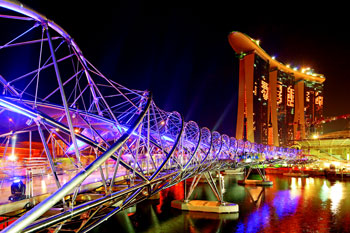
Singapore has been one of the successful countries in Southeast-Asia who are constantly engaged in urban renewal of the city. In order to create a vibrant and sustainable city, the Urban Redevelopment Authority (URA) has relentlessly endeavored to transform the metropolis with its innovative urban design concepts. With the successful completion of Marina Bay, URA expanded its urban development area by venturing into an innovative concept of pedestrian bridge – The Helix. It is one of its kinds, as it is surrounded by opposing double helix structures made from stainless steel. It is considered as one of the classic example of architectural excellence inspired by the geometric helicoidal arrangement of DNA measuring about 280 m and forms a part of a 3.5 km continuous waterfront promenade, linking the Marina Centre. The design consortium was an international team comprising Australian architects the Cox Group & Singapore based Architects 61 along with Arup as engineer consultants.
The creative use of duplex stainless steel and the efficient iterative design optimisation process resulted in an aesthetically lightweight and elegant structural form. Assembled with great precision, this architectural and engineering marvel has become a main attraction in Marina Bay. The Helix's unique architectural form and lighting effect offers a fascinating experience for pedestrian access, and an enjoyable view of the expansive skyline.
Dr. See Lin Ming, Project Leader – Arup feels that it was the design of the bridge that was challenging in this project. Responding to Built Expressions, he says, “The helix is a new form of structure for bridge design. A spiral or helix form is structurally inadequate and will not span between two supports to carry load and the helix mechanism will untwist when it is loaded. However, two helices can work together to form a bridge when they run in opposite directions and interconnected by a series of struts and tie rods. As they try to untwist, the rods work in two ways – they connect the two spirals together and at the same time, keep them separated. This gives the structural strength and stiffness to the bridge, making it a competent structure. The Helix is the first ever example of this structural solution applied to a significant bridge and it represents a design and engineering innovation. It is an entirely new classification of bridge structure."
The bridge is located in one of the focal points of the city - Marina Bay. So, when questioned Mr. Lin Ming about the level of design and quality of construction of the structures surrounding this bridge, he says, "This Bridge was intended to be an iconic and forward thinking design and was supposed to be the focus point of the entire marina bay. Hence, it was meant to surpass the level of design and construction of the surrounding buildings/structures."
DNA-Inspired Structure
|
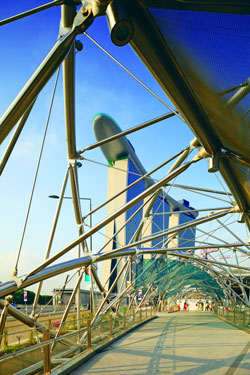
The Helix comprises two sets of separate spiralling steel members (the inner and outer helices) that encircle the entire length of the bridge, meeting only at the deck level. When viewed from the North Abutment, the outer helix extends around the deck in an anti-clockwise direction while the inner helix rotates around the deck in a clockwise direction.
|
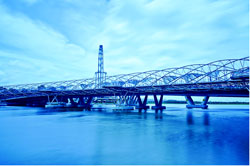 |
There are five curves along 280 meters length and the entire bridge can be seen along the curve. Explaining about the design aspect, Mr. Lin Ming says, "The Helix form is an entirely new form of structure. It is safely the first in the world, in terms of form and scale. The Helix’s design called for a lightweight and elegant structural form for aesthetic reasons. In the design, each component or member is optimised such that tubes in the major and minor helices have the same diameter. The steel thickness for each tube is then determined from the structural requirements. In this way, the outward appearance of the bridge remains aesthetically pleasing without compromising its functional needs. This entire design concept was developed in a virtual, 3D digital environment with Arup. A standalone optimization programme was used to interact with the commercial software."
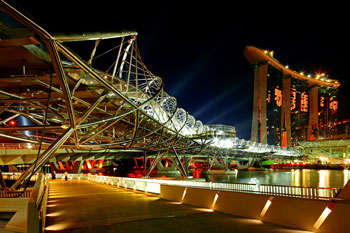
At every 2.7m along the length of the bridge, a hoop frame connected the two spirals together and provided the stiffness to the bridge. The hoop frame consisted of a series of compression struts forming the loop stiffening rings. Together, the outer and inner helices were tied together by tension rods.
Mr. Lin Ming explains about the execution process and says, "A structural analysis solver used to determine member forces on a loaded structure. By defining design criteria and parameters for member selection, the application writes section properties in the commercial software. It then iteratively solved the software's model, retrieves all of the section forces and analysed each element. Following that, it provided the utilisation ratio. Utilisation ratios for all applicable clauses in the steel design code were calculated and plotted as contour diagrams and tables for user output. If the utilisation ratios for all elements were not within a preset limit, the programme would iteratively solve the software model and calculate utilisation ratios for members in the structure. Member thickness and size in the 3D model was changed until all sections were within the user-defined range of utilisation. The entire process was completely automated."
The foundations for The Helix's piers consist of groups of 1.2m-diameter bored piles. A concrete pile-cap provides the structural connection to the piles and also serves to transfer the entire loads from the columns to the piles.
Lightweight and Elegant in Form
Duplex stainless steel was used for tensile strength and good fatigue resistance.
Duplex stainless steel Grade 2205 was selected as the design material, as it is highly resistant to pitting and uniform corrosion which is prevalent in lower grades of stainless steel when exposed to windblown salts. Duplex stainless steel combines the beneficial properties of ferritic and austenitic steel. The unique microstructure of duplex steel confers higher strength than common stainless steel grades, and provides good fatigue resistance. The result was a reduction in maintenance cost and also, smaller steel sections were required to achieve an aesthetically lightweight and elegant structural form.
The bridge is spanned across two ends. This was never attempted before by the engineers or architects. So, when asked about this design aspect, Mr. Lin Ming says, "In March 2006, the Urban Redevelopment Authority (URA) appointed the design consortium comprising an international team including global consulting engineers Arup, and architects from the Australian Cox Group and Singapore-based Architects 61. This successful collaboration emerged from a field of 36 bids to win the rights to design the first pedestrian crossing at Marina Bay. This defining project, based on the exciting submission, includes a pedestrian bridge - The Helix and a vehicular bridge - Bayfront Bridge."
He further adds, "The architectural and engineering marvels behind The Helix provided nothing short of a magical and intriguing experience for bridge users. As the bridge is designed to curve to connect seamlessly with the pedestrian promenade at the Bayfront and Marina Promenade, bridge users can see the entire structure of the bridge while crossing it. The 280m bridge, comprising five spans (three internal spans, each 65m and two approach spans, each 43m), forms part of a 3.5 km waterfront promenade that loops around the Marina Bay. The conceptual bridge was conceived jointly by the architects and Arup design team."
Energy-efficient and Visually Captivating
Dynamic multi-coloured LED lights installed to create a visual spectacle while achieving energy efficiency.
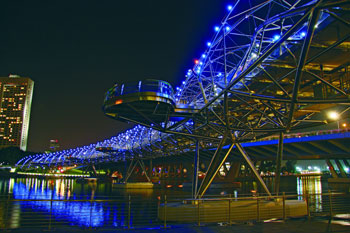
As this structure was inspired by the DNA structure, it was essential that the architectural lighting features should emphasise the various shapes and curves. Towards that end, a series of dynamic multi-coloured light-emitting diode (LED) lights were installed on the helix structures.
Commenting on the use of LED lights, Mr. Lin Ming explains, "A series of multi-coloured LED lights were installed in the helical strands to creatively reflect the unique structural form by night. The LED lights used were of high quality and they were also energy-efficient and visually captivating. These outward-facing luminaires were embedded into openings in the structural tubes to accentuate the sweeping structural curves. Combined with another discreet array of lights illuminating the internal canopy sections of laminated glass and stainless steel mesh, it creates a dynamic membrane of light - making it a visual spectacle from any view around the bay."
He continues, "The design of the viewing pods holds significance in that as it is meant to symbolise the elements of nature, namely, wood, water (glass) and metal. It is a belief that with the elements in place, life is in balance. These elements are showcased in the design through the materials used to decorate the pods. The viewing pods are spaced out evenly to capture the magnificent city view."
Pre-fabrication and Trial Assembly
Allowed the team to anticipate all possible challenges
Prior to the start of actual work, a mock-up of major joints such as the outer Helix Inner-Helix deck tubes connection of the bridge were commissioned, using carbon steel materials. The objective was to fully grasp the challenges involved when the actual bridge was being built.
The fabrication sequence started from the North Abutment down to South Abutment. The bridge components were fabricated in segments in the maximum dimension transportable with standard size trailers given Singapore's road restriction.
Trial assembly of the entire segments of the bridge was conducted during the course of the fabrication works to identify any fabrication error that may surface in the process. This was to ensure that all fabrication issues were being addressed while the members were still in the factory. With this approach, a worry-free and seamless erection of the bridge was maintained when the bridge components or members were sent to site and constructed accordingly.
Observance of Quality Assurance and Control
Ensured minimal contamination of the duplex stainless steel surface throughout
Quality Check played a significant role in the construction of the bridge from fabrication to its actual erection. It was important to avoid contamination of the duplex stainless steel surface by carbon steel at all stages of fabrication, handling, storage and erection. This was to prevent carbon steel pick-up, which might subsequently rust and stain the surface. To address this concern, a dedicated workshop was commissioned for duplex stainless steel materials. Since the segments were fabricated off-site, it reduced the amount of site welding and therefore, minimised potential contamination of the duplex material. Project Quality Assurance Procedures (PQAP) was developed for the project as a guideline for the entire fabrication and construction of the bridge. Various NDT tests and Destructive tests were also carried out during the fabrication and installation of the bridge.
Temporary Works
A temporary bridge was built to serve as a temporary platform to support the bridge and to provide access for erection of the bridge. One of the major challenges during the erection process was to provide a clear navigation channel clearance for the Central Span 3. The channel's width is 50m and the local authority required this to be maintained during the construction period for the safety of the marine vessels.
To resolve this challenge, the project team designed a 50m-long steel truss to span over the channel, and provide a safe clearance as required. Two trusses, with each divided into two segments, were used. To enable the installation of the truss segments, the segments were launched either by a tandem lift or synchronised lift by using two mobile crane units. The launching of the trusses took place during the night, with a temporary closure of the channel during the launching time.
Permanent Works
|
A mobile gantry was commissioned for the erection of The Helix's members. The mobile gantry was first installed at the North Abutment based on the construction sequence of The Helix. Once the completed segments were transported to site, the gantry was used to hoist the segments in place. The segments were then welded together to form the double-helix structure. The use of a mobile gantry minimised the need of mobile cranes, which made the erection easier and faster.
|
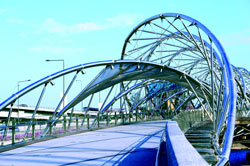 |
To ensure the accuracy of the alignment and level of each segment during installation, a full-time site surveyor was stationed on site to monitor the erection of the segments. The longitudinal deck tubes of the bridge were to be first installed throughout the entire length. The built up deck beams were then installed accordingly by bolting to the longitudinal deck tubes.
This was followed by bottom helix members and bottom hoop members from deck level to the bottom level of the bridge. The precast concrete deck was placed at the bridge deck level once the installation below the deck was completed. The precast deck provided working space for the installation of major and minor helices, and all the light struts and tension rods that hold and join the helices together. All the helices were held by welded connections while the struts and tension rods were secured by pin connections.
The final fitting-up and welding of joints in between segments were carried out after the entire span of the bridge was erected. Due to the duplex steel's austenite and ferrite composition, the temperature used during the welding process had to be controlled to ensure its chemical balance. Site welding of the joints was also a major challenge during the construction as the materials tended to become ductile when heated, hence affecting the profile or curve if not controlled adequately. Close supervision and monitoring during the process ensured its success.
The final stage of the work included installation of glass canopies, glass balustrades and passivation. The passivation process was to remove surface iron or iron compounds by dissolution. This action forms a protective passive film on the surface of the metal. The trace iron left behind from machining and fabrication could provide potential sources for corrosion if left untreated.
Innovative Manufacturing Technique
|
The Helix's opposing spiral geometry is a complex aspect and part of the challenge is to make this complex geometry simple enough for construction. To address this, innovative manufacturing technique using Arup's customised software was used to segment the bridge into hoops at every 2.7m, repeated every 13 segments to achieve standardisation.
StruCad software was used to develop the 3D model and profile each member for fabrication. StruCad was able to interactively build a solid representation of steel structure. Connection types can be assigned from a comprehensive library, or by creating them interactively. It was used for the preparation of shop/GA drawings and fabrication drawings of The Helix. The finished model was then divided into nine segments - North Abutment, Pod-1, Central span 1, Pod 2, Central Span 2, Pod 3, Central Span 3, Pod 4 and South Abutment.
|
 |
Cost Effectiveness and Benefits
The use of duplex stainless steel material provides corrosion resistance during the design life of the Helix. This provides significant saving on the future maintenance and replacement cost of the structure.
At the same time, the use of the standalone optimisation programme and Strand 7 software by Arup has allowed to optimise the member thickness and size - thus, saving on material cost while achieving desired structural strength and architectural appearance.
Environmental and Social Considerations
Embracing Arup's focus on sustainable design and development, the bridge uses five times less steel than a conventional box girder bridge. Additionally, the structure supports the pedestrian deck, shade canopies and light fixtures without the need for a separate secondary structure. The outcome is a visually appealing structure that is highly functional while using minimal resources.
Arup also used lighting methods and technology which reduced energy demands, while producing a visually impressive result. Specific lighting design techniques have been used to maximise the effectiveness of these luminaires.
Combined with careful placement, Arup's lighting designers have ensured that energy requirements are minimised. In fact, not a single individual light on The Helix consumes more than 12 watts of power.
Impact on the Profession at Large
A key landmark in Marina Bay, The Helix is a world first in architecture and engineering. It represents the importance of technical excellence to Arup's work and how they have harnessed the power of advanced technology to efficiently turn their ideas into reality. The Helix has created an entirely new classification for bridge structures.
With the successful completion of this project, Arup's local engineers can also empower themselves with tools of advanced technology and explore even more innovative ideas and structural forms in their work.
|
Mr. Lin Ming feels proud on the completion of the project and says, "This was definitely a memorable and challenging project as the bridge is built across a busy navigation channel and have to be maintained at all times. We had to take extra precautions to minimize impact of the environment and the on-going social activities around the bay area." He adds, "It was important to avoid contamination of the duplex stainless steel surface by carbon steel at all stages of fabrication, handling, storage and erection. This was to prevent carbon steel pick-up, which might subsequently rust and stain the surface. To address this concern, a dedicated workshop was commissioned for duplex stainless steel materials.
|
 |
On top of the environmental consciousness, the most basic challenge was the design, construction and testing process, given the scale and form of the bridge."
Mr. Lin Ming concludes by saying, "In totality, I felt great satisfaction after the completion of the project as this was an iconic project, even in years to come."
Project Details
Client: Urban Redevelopment Authority of Singapore (URA)
Key Collaborators: Cox in association with Architects 61, Sato Kogyo and TTJ
Key Facts: Project completed in April 2010
Encircled by a double-helix structure, the six-metre wide and 280m-long pedestrian bridge forms part of the 3.5km continuous waterfront promenade around Singapore's Marina Bay
Key Services Provided: Civil, structural, maritime, mechanical and electrical engineering, Lighting design
Awards
SSSS Steel Design Awards 2010
IStructE Singapore Structural Award 2010
ACES Design Excellence Award 2011
BCA Design and Engineering Safety Excellence Award 2011
Quick Facts
-
The pedestrian bridge symbolises 'life', 'continuity', 'renewal' and 'growth', which are Singapore's aspirations for Marina Bay. The bridge is designed to curve to connect seamlessly from Marina Centre to the pedestrian promenade at Bayfront
-
The Helix and Bay-front Bridge represent the direct links between Marina Centre and the Bayfront area. A walk from Marina Centre to Marina Bay Sands® Integrated Resort on The Helix will take about 3 to 4 minutes.
-
Across the length of the bridge, the major helix makes about four complete turns while the minor helix makes about five complete turns. The major and minor helices have an overall diameter of 10.8m and 9.4m respectively, approximately three-storey high.
-
The bridge weighs about 1,700 tonnes, equivalent to about 1,130 saloon cars.
-
The bridge has a 6m wide deck and is 280m in length. If all the steel tubes forming the major and minor helices are laid end to end, they will measure 2,250m, almost the length of a 2.4km fitness run.
-
Recreational pleasure boats can cruise through Marina Bay and Marina Channel as the bridge is built with a height clearance of 8.8m above water.
Dr See Lin Ming Profile
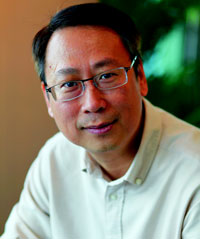
Dr See Lin Ming is a Principal in Arup, Singapore. He is well known in the Singapore construction industry and brings to the group a wealth of experience covering a wide range of projects from building to infrastructure both in Singapore and abroad.
Lin Ming belief in the ideals of good quality design and its integration into the design process provides a good fit to the Arup culture. His existing experience and structural intellect will be augmented.
Lin Ming is passionate for exploratory design and drawn to design challenges that present themselves as opportunities to revolutionalise current industry conventions.