Common Terminology in Water Proofing
Above-grade waterproofing- The prevention
of water intrusion into exposed structure elements through a combination of materials
or systems. These materials are not subject to hydrostatic pressure but are exposed
to weathering and pollutant attack.
Absorption- An Accumulation of water or moisture vapours
directly into a material’s structure of cells or fibres.
Accelerated weathering- Controlled conditions applied
in laboratory testing to condense greatly the weathering a waterproofing material
would experience over a long life cycle. Test results are used to compare materials
of different generic types or manufacturers.
Acrylic sealants - Factory-mixed, one-component materials
polymerized from acrylic acid. They are not used on joints subject to high movement
due to their relatively low-movement capability.
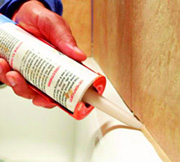
Adhesion - The ability of a waterproof material to
bond to a substrate or other material during movement or stress.
Adhesive failure - An after – installation failure
of the bond between a waterproofing material, such as sealant, to the substrate
surface.
|
 |
Adhesive strength - The ability of sealants to bond
to a particular substrate, including adhesion movement or stress.
Admixtures - Materials added to masonry or concrete
envelope components to enhance and improve in-place product performance.
|
Adsorption- The surface absorption of waterproofing
system. Testing for adsorption is carefully controlled under laboratory conditions
to ensure uniform test results between different waterproofing materials.
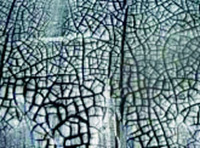
Alligatoring- The cracking that occurs on a waterproofing
material because of movement the material is not capable of withstanding. Alligatoring
also occurs when substrate movement begins before final waterproofing material curing.
Backing materials - Backer rods and backing tape that
prevent three- sided adhesion in joint design. When joints have insufficient depth
for backer-rod installation, tape is used at back of joints,
|
|
providing there is a firm substrate against which to install sealant. Backer rod
is installed in joints where there is no backing substrate. Backing material also
provides a surface against which to tool material and helps to maintain proper depth
ratios.
Bag grouting - Application of a cementitious waterproofing
material to the entire face of a masonry envelope. The cementitious material is
removed before it is completely set and cured by using burlap bags or stiff brushes.
This is also referred to as face grouting because the entire face of the masonry
facade is covered.
|
Barrier system - A building envelope component or
waterproofing system that completely repels water rather than diverting it.
Base flashing - Flashing that prevents water from
wicking upward in capillary action in a masonry wall.
Below-grade waterproofing- Use of materials that prevent
water under hydrostatic pressure from entering a structure or its components. These
systems are not exposed or subjected to weathering such as by ultraviolet rays.
Bentonite waterproofing- Waterproofing materials composed
primarily of montmorillonite clay, a natural material. Typically, bentonite waterproofing
systems contain 85-90 percent of montmorillonite clay and a maximum of 15 percent
natural sediments such as volcanic ash.
|
 |
Blister- A portion of a waterproofing material raised
from the substrate because of negative vapour pressure or application over wet substrates.
Building envelope- The combination of roofing, waterproofing,
damp proofing, and flashing systems that act cohesively as a barrier, protecting
interior areas from water and weather intrusion. These systems envelop a building
from top to bottom, from below grade to the roof.
Butyl sealants- Sealants produced by copolymerization
of isobutylene and isoprene rubbers. Butyls are some of the oldest derivatives to
be used for sealant materials.
Cant- The angled or bevelled transition between a
horizontal and vertical substrate that provides for a smooth transition between
this change-in-plane details. Also refers to the application of waterproofing material,
such as cementitious coatings or sealants, applied at this intersection.
Capillary admixtures- Admixtures that react with the
free lime and alkaline in a concrete or masonry substrate to form microscopic crystalline
growth in the capillaries left by hydration. This crystalline growth fills the capillaries,
resulting in a substrate impervious to further capillary action.
Caulking - Joint sealing material appropriate for
interior joints that exhibit little or no movement.
Chemical cleaning- A cleaning method using a variety
of chemical formulations to remove a number of substrate stains including paint,
rust, and pollutants
Chemical grouts- Similar in application to epoxy injection
repair; however, these materials are manufactured from hydrophobic liquid polymer
resins. Chemical grouts are used for waterproofing cracks in a substrate and not
for structural repairs.
Cohesive strength - The ability of a material’s
molecular structure to say together internally during movement. Cohesive strength
has a direct bearing on elongation ability.
Construction joint- A Joint formed at the intersection
of two separate concrete placements.
Contaminants-Foreign material found on a substrate
such as oils, curing agents, dust, dirt, or rust.
Control joint-A joint in building or envelope materials
that allows for substrate movement.
Copings- A protective, waterproof covering placed
on the top of a structure such as a parapet wall.
Counter flashing- Flashing that is surface-mounted
or placed directly into wall with a portion exposed to flash various building elements,
including roof flashings, water- proofing materials, building protrusions, and mechanical
equipment, into the envelope.
Curing agent- A separate material applied immediately
after application to waterproofing materials or substances. Curing agents enhance
curing time and properties.
Damp proofing- A system that is resistant to water
vapour or minor amounts of moisture and that acts as a backup system to primary
waterproofing materials. Damp proofing materials are not subject to weathering or
water pressure.
Delamination - Separation of envelope materials from
the applied substrate due to movement or improperly applied materials.
Detailing joints- Joints required as a component or
part of complete waterproofing systems. They are used for water tightness at building
details such as pipe penetrations and changes in plane before application of primary
waterproofing materials.
Differential movement - A phenomenon that occurs because
materials have the individual characteristics of coefficients of movement that differ
from surrounding envelope materials or systems. These differences will cause the
materials to move at different rates during substrate movement.
Drainage systems- Prefabricated materials that facilitate
the drainage of water away from the building envelope.
Dual –cell foams- A backer rod that is comprised
of both open – and closed – cell structures.
Efflorescence- The staining and discolouring of masonry
walls created by water – carried acids and chemical.
Elasticity- The measure of a sealant’s ability
to return to its original shape and size after being compressed or elongated. As
with elongation, elasticity in measured as a percentage of its original length.
Elastomeric - An adjective describing the ability
of a waterproof material to return to its original shape and size after substrate
movement during expansion or contraction.
Elongation- The ability of sealant to increase in
length, then return to its original size. Limits of elongation are expressed as
a percentage of original size. A material with a 200 percent elongation, for example,
is capable of stretching to double its original size without splitting or tearing.
Epoxy injection- The injection of low-viscosity epoxy
materials into substrate cracks to restore the monolithic nature of the substrate.
These can be used on wood, concrete, masonry, natural stone, or metal substrates.
If additional substrate movement occurs, the epoxy may crack.
Expanding-foam sealants- These are composed of open-cell
polyurethane foam fully impregnated with a manufacturer’s proprietary product
formulation. These products include neoprene rubbers, modified asphalts, or acrylic
materials.
Expansion joint - A break or joint in structural elements
of a building that will continue to experience movement by thermal expansion and
contraction.
Exposed flashings - Flashings used in a variety of
methods and locations. They can be an integral part of a system, such as skylight
construction, or applied to provide protection between two dissimilar materials,
including cap flashings, coping flashings, gravel stops, and edge flashings.
Flashing- A material or system installed to redirect
water entering through the building skin to exterior. These are made from a variety
of materials including noncorrosive metals and synthetic rubber sheet goods. Flashings
are installed as backup systems for waterproofing or damp proofing systems. They
are also used for waterproofing material transitions or terminations.
Freeze-thaw cycle - The cycle of water freezing, and
subsequently thawing, related to building-related components.
Gravity feed: The movement of materials from
one location to another by force of gravity.
Gunite - Pneumatically applied, small aggregate concrete
or sand-cement mixtures, which are also referred to as shotcrete.
Hydration- The Process of adding water to cement,
sand and aggregate, to form a paste that cures, hardens, and shrinks to create the
finished concrete or masonry product. During curing, water leaves this paste through
a process called dehydration, which causes formation of microscopic voids and cracks
in concrete. Once formed, these voids allow water absorption through the material.
Hydraulic cement- Frequently referred to as “hot
patch” materials, because of the heat generated during their extremely fast
cure cycle. These materials are used to patch substrate cracks and small areas experiencing
water leaking under hydrostatic pressure.
Hydrophilic- The chemical properties that attract
of absorb water.
Hydrophobic - The chemical properties for repelling
or diverting water away from a material or substrate.
Hydrophobic expansion systems - Systems combining
hydrophobic resins with synthetic rubber to produce hydrophobic expansion seals.
The term hydrophobic refers to materials that swell in the presence of water. Thus,
these materials require active water pressure to become effective water barriers.
Hydrostatic pressure- Pressure applied to envelop
materials by various height of water at rests.
Infiltration - Ingress of water,
moisture, vapour or air into a building envelope.
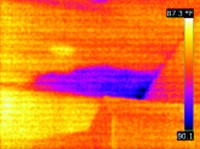
Infrared thermography: A non-destructive testing
method for locating delaminations in pavements and bridge decks and detecting moist
insulation, concrete, and wood in buildings; the presence of flaws within concrete
affects the heat conduction properties of the concrete and the presence of defects
is indicated by differences in surface temperatures when the test object is exposed
to correct ambient conditions. In the waterproofing industry it is typically used
to detect moisture behind closed walls by detecting evaporative moisture cooling
(EMC).
Isolation joints - Joints that allow for any differential
movement that will occur between two materials at junctures of these materials.
For example, window frame perimeters require isolation joints when abutting other
facade materials. These joints allow for differential movement at such locations
as changes in structural components (e.g., spandrel beam meeting brick facing material).
Joint grouting- Application of cementitious grout
to all surfaces of existing mortar joints, to repair the structure and waterproof
effectively.
Laitance - A thin layer of un-bonded cement paste
on concrete substrate surfaces that must be removed before waterproofing material
application.
Latex sealants-Typically, acrylic emulsions or polyvinyl
acetate derivatives. Latex materials have limited usage for exterior applications.
They are typically used for interior applications when a fast cure time is desired
for painting.
Membrane-A flexible or elastomeric waterproofing material
applied to a building envelope.
Millage - A unit for measuring the thickness of waterproofing
products. One mil is equal to one-thousandth of an inch.
Modulus- A measure of stress to stain; measured as
tensile strength, expressed as a given percentage of elongation in pounds per square
inch (1b/in2). Modulus has a direct effect on elongation or movement capability.
Moisture content Movement- Movement caused by certain
materials, particularly masonry substrates, swelling then subjected to wetting and
subsequent drying. When this movement is calculated as an aggregate total of the
entire façade area, it can be considerable.
Negative waterproofing- Below-grade waterproofing
systems applied to the interior or negative side of a structure, away from direct
exposure to groundwater.
Organic-A product comprised or manufactured of hydrocarbons,
plants, animal, or their derivatives.
Out gassing- The deterioration of a closed-cell backer
material that causes the sealant material to improperly cure and often leads to
failures.
Overlays- Cementitious materials used for restoring
deteriorated horizontal concrete substrates.
Parapet flashing- Flashing installed at the base of
a parapet usually at ceiling level. It is also used on the roof side of parapets
as part of roof or counter flashing. See Flashing.
Perm - The rate of water vapour transmission through
a substrate or material of one grain per hour per square foot per inch of mercury
pressure difference.
Permeability -The ability of a waterproofing material
or substrate to allow the passage of water vapour through itself without blistering.
Ph-The chemical measurement of a substrate’s
alkalinity or acidity.
Polymer concrete- A modified concrete mixture formulated
by adding natural and synthetic chemical compounds known as polymers. Although the
priority chemical compounds (polymers) vary, the purpose of these admixtures is
the same. They provide a dense, high-strength, low-shrinkage, and chemically and
water-resistant concrete substrate.
Polysulphides-Materials Produced from synthetic polymers
of polysulfide rubbers. Polysulphides make excellent performing sealants for most
joint uses.
Polyurethane- Any of various polymers that are produced
by chemical reactions formed by mixing di-isocynate with a hydroxyl, and are used
in making flexible and rigid foams, elastomers, and resins. Many types of polyurethane
are moisture-cured materials reacting to moisture in atmospheric conditions to promote
curing. Other polyurethanes are chemically curing mixtures.
Positive waterproofing-Waterproofing systems applied
to substrate side with direct exposure to water or a hydrostatic head of water.
Pot life-The length of time a waterproof material
or system is workable or applicable after having been activated.
Poultice- An absorbent material such as tale or fuller’s
earth that is applied to the envelope substrate to remove dirt the staining. The
poultice absorbs the staining and dirt into itself, and then is removed by water
pressure cleaning.
Primer-A separate material, usually in liquid form,
applied to a substrate before actual waterproofing system application. Primers enhance
adhesion properties of the water proofing system.
Protected membrane-A membrane applied between a structural
slab and topping slab or other top layer protection such as tile. The topping slab
or protection slab protects the membrane from weathering and traffic wear. This
is also referred to as a sandwich membrane.
Protection Layer-A layer of rigid or semi-rigid boards
or sheets installed directly over a waterproofing system application to protect
the waterproofing material from damage during back-fill or concrete placement operations.
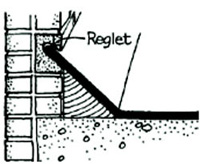
Reglet -A formed or sawn groove in substrate (usually
concrete) providing a transition point for two adjoining waterproofing systems.
Sealant - A material applicable to exterior building
envelope joints. Sealants are capable of with standing continuous joint movement
during weathering conditions without failing.
Shear movement-Lateral movement in a substrate.
Sheet expansion systems-Systems manufactured from
neoprene or hypalon rubber sheets. Joint expansion and contraction is made watertight
by installing these materials in a bellows or loop fashion.
Shelf angle-Steel angle extrusion used over envelope
openings to support masonry and precast and other cladding materials.
Shelf life-The maximum time that packaged and unopened
waterproofing materials can remain usable.
Shore hardness-A measure of resistance to impact using
a durometer gage. This property becomes important in choosing sealants subject to
punctures or traffic, such as horizontal paver joints. A shore hardness of 25 is
similar to a soft eraser: a hardness of 90 is equivalent to a rubber mallet.
Silanes -Water repellents that contain the smallest
molecular structures of all silicone – based materials. The small molecular
structure of the Silanes allows the deepest penetration into substrates. Silanes
must have silica present in substrates for the chemical action providing water repellence
to take place. These materials therefore are inappropriate for substrates such as
wood metal, and limestone.
Silicone rubber-A water repellent manufactured from
silicone elastomers that has a millage usually greater than other silicone-based
sealers.
|
Silicone water repellent-water repellents manufactured
by mixing silicone solids (resins) into a solvent carrier. Most manufacturers base
their formulations on a 5 percent solids mixture, in conformance with the requirements
of federal specification SSW-110C.
Silicones-Silicone sealants are derivatives of silicon
polymers produced by combining silicon, oxygen and organic materials/ Silicones
have extremely high thermal stability and are used as abrasives, lubricants, paints,
coatings, and synthetic rubbers. See Sealant.
Sodium silicates-Materials that react with the free
salts I concrete, such as calcium or free lime, making the concrete surface more
dense. Usually these materials are sold as floor hardeners.
|
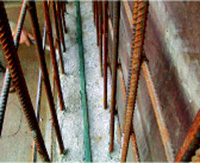 |
Spall/spalling-The crumbling or breaking off in small
pieces of a concrete or masonry substrate, usually owing to freeze thaw cycles or
deterioration (rusting) of embedded structural elements such as reinforcing steel.
Substrate - Structure or envelope components to which
waterproofing materials or systems are applied.
Surface tension: A phenomenon caused by the attraction
of molecules to like molecules. As molecules on the liquid surface are not surrounded
by the same molecules on all sides, there is a resultant increase in their attraction
to neighbouring molecules on a surface.
Swale: A shallow trough like depression that
carries water mainly during rainstorms or snow melts.
T-joint system - A sealant system reinforced with
metal or plastic plates and polymer concrete nosing on each side of the sealant.
This system derives its name from a cross section of the joint, which is in the
shape of a T.
Tackiness-Stickiness of a waterproofing material’s
exposed surface after installation or during its final curing stage.
Tensile strength -The ability of a waterproofing material
to resist being pulled or stretched apart to a point of failure.
Thermal movement - Movement, either expansion or contraction,
caused by temperature changes.
Thixotropic paste: Paste used to anchor injection
T-ports to the wall which acquires a lower viscosity when mechanically agitated,
and rapidly stiffens upon subsequent rest; a material having this property can be
placed vertically or horizontally without sagging during the curing process. This
is the type of paste used for low pressure crack injections of epoxy and
polyurethane resins.
Tooling- The means of finishing mortar or sealants
that have been applied into envelope joints.
Tuck-pointing -The repair of existing mortar joints
in masonry walls by removing the old material and filling with new mortar.
Ultraviolet-A form of light energy positioned in the
spectrum of sunlight beyond violet, the limit of visible light, that is an especially
detrimental weathering condition to above-grade waterproofing materials and envelope
component.
Viscosity -The chemical property of liquid waterproofing
materials to resist a change in shape.
Water cleaning-A building cleaning method incorporating
water by pressure, soaking, or steam to remove dirt and pollutants from a substrate.
Water penetration / Infiltration -The circumstance
in which water accesses the interior areas of a building envelope.
Water-stops-Preformed materials placed between construction
joints in separate concrete placements to prevent passage of water between the joints
that forms at this intersection.
Weep hole-Opening in a masonry wall or sealant that
allows the escape of water entering envelopes to the exterior. Exiting water is
collected by a combination of damp-proofing and flashing materials.