The Radical Centre of Dalian
Dalian International Conference Centre, China
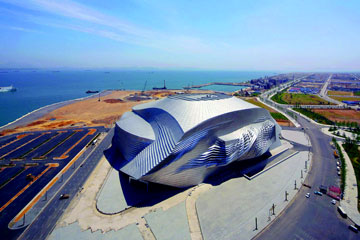 |
Dalian is a major business hub among the other cities of China located at the tip of the Liaodong peninsula closer to the Yellow sea. Since the city is a major seaport of the country it has a sub provincial status and presently the financial, shipping, logistics center for Northeast Asia. Apart from being a large seaport, it is a home for some of the amazing structures. The Dalian International Conference Center is comparable to the world's most famous modern buildings. Austrian architecture practice Coop Himmelb (l) au has completed the Dalian International Conference Center in China. Located by the harbor in the city of Dalian (located in the southernmost part of the Liaodong Peninsula in the Liaoning Province), the building features a sweeping, faceted facade and, on the inside, a 1600-seat theatre and concert hall, a primary conference room for up to 2500 delegates (that can be turned into a banqueting hall, an exhibition gallery or extra seating for the concert hall), and six additional conference spaces whose capacity varies between 300 and 600 seats.
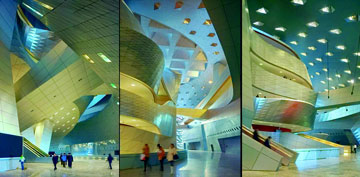 |
The project with a dimension of 220m by 200m extends over 8 floors and combines numerous different functions within a single hybrid building on a total of 117,000 m²: a conference center, an opera house and an exhibition center as well as a basement with parking, delivery and disposal area. In the center is a grand 1,800 seats theater and opera house with stage and a flexible conference hall for 2,500 visitors. The urban development strategy for the Dalian International Conference Center aims to create a distinctive landmark at the new endpoint of the main urban axis in the future extension area of the city.
The Body Arrangement
 |
The Dalian Conference Center is associative in its architectural concept rather than pictographic, taking on the softness of form as though eroded by forces of the sea. The design incorporates a public zone with shopping at ground level and a 1,900 seat theatre and 2,500 capacity conference spaces situated 15m above the entrance hall as floating spaces. Smaller conference spaces are situated around this core space. The main structure of Dalian International Conference Centre comprises a horizontal and a cone shaped spatial steel frameworks, which are mainly supported by 10 concrete cores. Centre of DCC is the freeform shaped main conference hall, envisaged as reinforced concrete shell. The main loads of this hall are carried by four concrete cores; additional columns may be utilized to minimize the halls span length. Six smaller, box-shaped conference halls of various sizes are arranged around the main conference centre. These rectangular halls are made of reinforced concrete shear walls. Depending on their wall height and geometry they are able to cantilever from their supports.
Architectural Concept
The urban design task of the Dalian International Conference Center is to create an instantly recognizable landmark at the terminal point of the future extension of the main city axis. As its focal point the building will be anchored in the mental landscape of the population and the international community. The footprint of the building on the site is therefore arranged in accordance with the orientation of the two major urban axes which merge in front of the building. The cantilevering conference spaces that penetrate the facades create a spatially multifaceted building volume and differentiate the close surroundings.
The building has both to reflect the promising modern future of Dalian and its tradition as an important port, trade, industry and tourism city. The formal language of the project is not pictographic, but associative; it will combine and merge the rational structure and organization of its modern conference center typology with the floating spaces of traditional Asian architecture as well as with a design reminiscent of the soft surfaces generated by the forces of the sea.
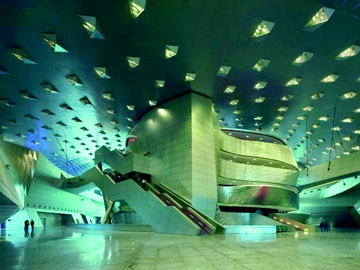 |
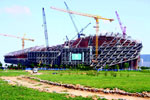
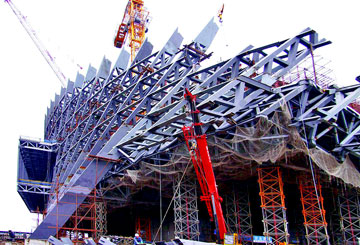
The structural concept is based on a sandwich structure composed of 2 elements: the 'table' and the 'roof'. The whole structure is elevated 7 meters above ground level and is supported by 14 vertical composite steel and concrete cores. A doubly ruled facade structure connects the two layers of table and roof, creating a load-bearing shell structure. The application of new design and simulation techniques, the knowledge of local shipbuilders to bend massive steel plates, and the consumption of more than 40,000 tons of steel enables breathtaking spans of over 85 meters and cantilevering of over 40 meters.
Utilizing Natural Resources
The Dalian center was planned according to sustainable principles, a sophisticated climatic concept, which includes for example the use of sea water for cooling, will yield 30% energy saving or CO2 reduction respectively. The focus of the architectural design and project development lies on technology, construction and their interplay. Various sustainable principles were applied prior to the execution of the project. One of the major tasks of sustainable architecture is the minimization of energy consumption. A fundamental contribution is to avoid considerable fluctuations in demands during the course of the day. Therefore it is essential to integrate the natural resources of the environment like to make it sustainable.
 |
Use the thermal energy of seawater with heat pumps for cooling in summer and heating in winter. General use of low temperature systems for heating in combination with activation of the concrete core as thermal mass in order to keep the building on constant temperature. Natural ventilation of the huge air volumes within the building allows for minimization of the mechanical apparatus for ventilation heating and cooling. |
The atrium is conceived as a solar heated, naturally ventilated sub-climatic area. In the large volume individual areas can be treated separately by additional measures such as displacement ventilation. A high degree of daylight use is aspired both for its positive psychological effect and for minimizing the power consumption for artificial lighting. Energy production with solar energy panels integrated into the shape of the building.
Multipurpose Structure
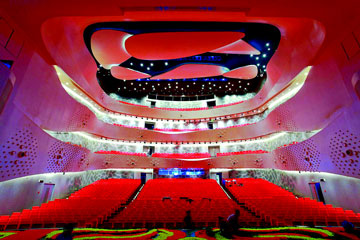
The center comprises of a conference center, theater and opera house. The theater has a capacity of 1,600 seats and a stage tower, exhibition center and parking, delivery and disposal. A public zone at ground level allows for differentiating accessibility for the different groups of users, with the shopping and exhibition facilities directly connected to the conference center providing dramatic sight axis within the building. The actual performance and conference spaces are situated at +15 m above the entrance hall. The grand theater, with a capacity of 1,600 seats and a stage tower, directly opposite of a flexible conference hall for 2,500 seats, is positioned at the core in the center of the building. With this arrangement the main stage can be used for the classical theater auditorium as well as for the flexible multipurpose hall. The main auditorium is additionally equipped with backstage areas like in traditional theaters and opera houses.
 |
This scheme is appropriate to broaden the range of options for the use of this space: from convention, musical, theater even up to classical opera, with very little additional investment. The main auditorium has the option to get equipped with a flexible floor providing all possible utilization from banquet to parliamentary seating. The smaller conference spaces are arranged like pearls around this core, providing very short connections between the different areas, thus saving time while changing between the different units. Most conference rooms and the circulation areas have direct daylight from above.
Acoustics
Architecturally as well as acoustically, the opera hall is the core of the building. The hall's design with three balconies connecting the lateral walls and rear walls is inspired by the traditional horse shoe shape; however it has been interpreted in an entirely new way. The curved balustrades merge into the proscenium walls and ceiling. Furthermore, all surfaces including the suspended reflector elements were designed acoustically as well as architecturally by means of a computer model. The aluminum wall panels with their varying perforation pattern form the characteristic design and are acoustically transparent, while by means of the height- adjustable acoustic banners behind the wall cladding, perfect acoustics can be ensured for each respective type of event. But, the hall even features another acoustic finesse: the Vivace system, originally designed for theater performances that has been complemented by an electronic room enhancement module.
Facade
The 30,600 m² building's exterior facade is covered by aluminum metal panels QuadroClad. This system to screen light penetration controls facades from rain, maintained ventilation and provides thermal insulation. The technical and environmental concepts behind the conference center are closely aligned with the criteria of sustainability a philosophy which partly prompted the use of aluminum for the interior and exterior wall cladding. About 700 tons of Aleris 55HX were fitted both inside and outside the Dalian International Conference Center. The aluminum was supplied by the Bremen based trading Melchets who had several reasons for choosing the Aleris alloy. First the anodized aluminum has a high surface quality and is excellent for shaping. Additionally, Aleris not only guarantees color integrity across numerous casting batches but also long term color stability under all weather conditions, which is an important factor so close to the ocean.
The magnificent work by the architect on this structure is extremely appreciable in terms of its opulent design. The center will also be a major attraction to the tourists entering into the city through the port. Most importantly the multiple platforms present in the structure is an added advantage to its visitors who can access the center very easily. Thus the Dalian International Conference Center is a new iconic figure emerged in the Liaoning Province
EOM
Fact Sheet
Project name: Dalian International Conference Center
Location: Dalian, China
Type: Theatre and Auditorium
Number of Floors: 8
Building Height: 60 m
Building Length: 220 m
Building Width: 200 m
Site Area: 40,000 sqm
Gross Floor Area: 117,650 sqm
Gross Floor Area Conference Center: 91,250 sqm
Footprint Area: 33,000 sqm
Gross Cubage above ground: 1,250,000 Cum
Gross Cubage underground: 220,000 Cum
Façade Area: 30,600 sqm
Roof area: 28,000 sqm
Completion Year: 12/2012
Client / Owner / Developer: Dalian Municipal People’s Government, P.R. China
Architects: Coop Himmelb(l)au – Spengergasse 37, A – 1050 Vienna, Austria
Design Principal: Wolf D. Prix
Project Partner: Paul Kath (until 2010), Wolfgang Reicht
Project Architect: Wolfgang Reicht
Design Architect: Alexander Ott
Design Team: Quirin Krumbholz, Eva Wolf, Victoria Coaloa
Source :
http://www.coop-himmelblau.at/architecture/projects/dalian-international-conference-center
http://www.designboom.com/architectur