Recreating the Passenger Terminal Complex
Denver International Airport

Airports are no more just runways for reaching desired destinations instead airports are becoming the symbol of culture representing each country. With the emerging designs in the field of architecture, the airports have been designed and redesigned to represent the metropolitan cities. Similarly, when the City and County of Denver decided to design a terminal building for Denver airport it asked Fentress and his team to prepare a conceptual design. The City stipulated the design firm to make the terminal building a symbol of and a gateway to the region, a building that would be as memorable as it was functional.
Salient Features
Denver International Airport has a capacity for 12 runways (55 miles of runways). Due the wind shift, the runways are placed strategically in different directions to accommodate the variation. With 300 domestic gates, the airport serves over 100 million passengers a year. The design of the building and the airport employs state-of-the-art equipments such as the elevators, escalators, travelators, conveyors, x-ray machines, boarding bridges and HTP are made available at the airport. The DIA terminal is a metaphor for place, culture and imagination.
Fentress took a new approach to this outdated design theory. The project was seen as an economic driver: a rare gift of 53 square miles of open land ready for commercial and residential development in an early concept of an airport city.
With a deadline of only three weeks to create the terminal's conceptual design, Curtis Fentress, Principal - Fentress Architects broke the mold of traditional airport architecture by "turning the building upside down." The form evokes the majestic snow-capped peaks of the Rocky Mountains, Colorado's international signature. Sustainably, the fabric roof provides considerable day lighting, and low heat absorption reduces build-up due to sunlight radiation. When the Fentress studio began working on it, DIA was behind schedule and over budget. Fentress designed expansive glass curtain walls that brought in the mood-elevating Colorado sun, adding sustainability to the building and setting the stage for a more sustainable building.
Pre-construction of DIA
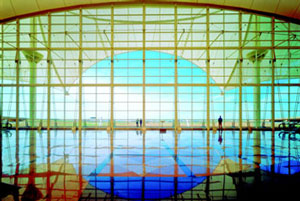
When the Fentress studio began working on it, the Passenger Terminal Complex was behind schedule and over budget. The project was seen as an economic driver: a rare opportunity of 53 square miles of open land ready for commercial and residential development in an early concept of an airport city.
Explaining about the pre-construction challenges faced while designing the project Fentress says, "Working on a three week deadline, our design team determined that the answer to the city’s budget problems was to flip the terminal upside down, putting mechanical systems in the basement and designing a Teflon-coated, fabric roof that was durable and unique. The design was affordable, as it required less steel, concrete and time to build."
"We were able to take out 300 tons of steel and 200,000 linear feet of concrete foundation walls," says Fentress, saving the city $115 million. "We designed it so that the roof was erected very quickly, allowing more time for interior construction below the roof," he adds.
Terminal Building Design
Commenting on the design aspect of the Passenger Terminal Building Fentress says, "Inspired by the majestic Rocky Mountains and the surrounding Colorado terrain, Denver International Airport is designed to be a memorable expression of civic pride and sense of place. The entire passenger terminal complex is designed using state-of-the-art building materials to create a user-friendly facility of the highest comfort, convenience and efficiency. The building is day lit in such a way that the Great Hall space appears as an indoor-outdoor room-truly emulating a great civic space. Denver International Airport is a gateway to Colorado and the West."
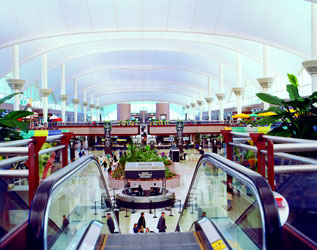
Just as Eero Saarinen's design for Terminal 5 at John F. Kennedy International Airport relied on sculptural form to explore the metaphor of flight, "DIA is iconic. It's emblematic, this fine edge working with structure, working with form, and working with the building to express something that is not too literal," says Fentress.
Integrated Tensile-Membrane Roof
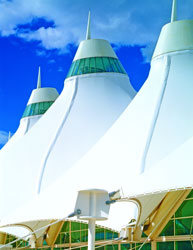
| Elucidating the unique aspect of the project Fentress says, "As the largest architecturally integrated tensile-membrane roof (with windows) in the world, the Denver International Airport Passenger Terminal is a threshold of lasting permanence welcoming all to Colorado and the West. Entering the main terminal, roof peaks rise to heights ranging 130-150 feet. The roof material allows 10 percent of visible light to pass through the fabric for day lighting, diminishing 90 percent of the high-altitude ultraviolet rays."
City officials feared the fabric roof might not hold up under Colorado's occasional snow dump, especially on the plains east of Denver. But Fentress' then-partner James Bradburn had visited structures with fabric roofs in Canada to learn about their performance.
|
 |
Precautionary Measures
Commenting on the safety measures considered in the design of the project Fentress says, "We maximized the manufacturing of the roof and many other components of the building so that they could be manufactured in factories and assembled on site. This reduced the complexity of on-site construction, thus reducing the safety risks."
Now, this appealing terminal building stands out to be a best designed and has won many rave reviews. A survey by the American Institute of Architects ranked the terminal as No. 4 on its list of favorite American architecture landmarks, while Business Traveler magazine readers voted DIA the "Best Airport in North America" every year for the last six years, 2005-2010. As the largest structurally integrated tensile-membrane roof in the world, DIA is a memorable threshold welcoming all to Colorado and the West.
EOM
Denver International Airport, Passenger Terminal Complex
Fact Sheet and Extra Text
Project: Denver International Airport Passenger Terminal Complex
Location: Denver, Colorado
Client: City and County of Denver
Size: Building - 2,000,000 square feet (185,800 square meters)
Number of Gates: 94
Concept to Completion: November 1989-February 1995
Major Consultants
Structural: S.A. Miro, Inc. and Severud Associates Consulting Engineers
Mechanical: Black and Veatch
Electrical: Roos Szynskie, Inc.
Civil: Martin/Martin