Green Architecture and Construction
Prof. Dr. Soontorn Boonyatikarn
Center of Excellence Building and Environmental Technology,
Department of Architecture, School of Architecture,
Chulalongkorn University, Thailand
cubest11@gmail.com
Abstract
The world today has encountered with global warming and climate change which effect directly and indirectly in building design. The design of house with energy concern becomes part of solutions that can expand from the small unit to the national scale. One of the major design techniques of Bio-solar Home had been developed from Thai traditional wisdom in scientific approach that it seems the basic needs for habitation in hot -humid climate. Bio-solar Home can produce its own energy and supply left over energy to public. Since the successful of Bio-solar home was developed, the idea has distributed through Thailand. Many people were interested in and would like to apply the idea in the affordable cost housing. Therefore, the Eco-home was introduced to make it possible by managing cost, material, construction techniques, and labor and construction time. The Eco-home is the future generation that goes beyond Bio-solar home.
The Eco-home answers all requirements such as, good performance energy reduction environmental preservation, affordable cost and truly sustainable living by integrated new innovation. The new innovations are new construction techniques, new design integration concept, new material that all combination success by working together between material researcher, architect, landscape, engineer, and construction.
Keyword
Sustainable solution, green architecture, construction technique, design integration, new material
Introduction
A green architectural concept was continuing developed for a long time. It becomes general issue. Most concepts concerned about energy conservation and natural environment preservation. Some projects or concepts which only have a little success have claimed these were green architecture.
After that, there are global warming problem and climate change problem. There are many green architectural concepts that try to link them with the global warming solution, although there is a slightly correlation between them. In general, they believe that energy conservation is a part of the solution because when we reduce energy consumption CO2 emission will reduce too. Therefore some energy conservation building claimed that they can solve the global warming by reducing energy consumption that shown in the new paradigm shift in global warming solution (figure 1).
Figure 1: New paradigm shift in global warming solution. (Buranakarn, 2009)
Sustainable-architectural concept
The Bio-solar home which developed since five years ago proofed that the truly sustainable can be done, and it also provided a high quality of living. This home is the one of successful sustainable solution. This home does'?t need water supply from the municipal supply. There is self water production, which comes from different source such as dew, water from the air condition system, and rainwater collection. It also uses recycle water. This home doesn't need electricity from grid, on the other hands there is self production electricity from solar. There is some surplus electricity sold back to the grid. And there is biogas production in this home from grass, waste water, and garbage.
Although the Bio-solar home was successes, the construction cost is still a little bit higher than the typical house. And it also needs construction time similar to a typical house. The Bio-solar home may not the final solution for general people whose incomes lower than the average incomes.
Figure 2: The Bio-solar home.
Objectives
The objectives of the Eco-home are to provide good performances with affordable cost for middle class income in reasonable construction time. As the next generation in the future, this home needs to develop new construction techniques and new design integration concepts that can reduce cost and time but able to provide good performances. The good performance in this paper is concern about low energy consumption and high quality of living. These emerge the usage of new materials that have proper properties to reduce energy consumption. These materials are also recycling material that is a part of environmental preservation. By understanding the usage of new construction technique, new design integration, and new material, Eco-home will developed varies building forms that still provide good performances.
Beyond green architectural concept
From Bio-solar home concept, it increases demand of true environmental house but the construction cost still very high. The global warming issue has also influenced on energy consumption especially for the building and housing. The operation cost has played the major role. The question is how affordable house can be more efficient as good as Bio-solar home. Reducing construction cost is very important. Well understanding in each construction process is very significant. It has taken over 30 years of development and experiences for more than 3,000 houses around the world.
The construction is developed by copying knowledge from past generation. These knowledge are collecting bit by bit and become their habitude which are unchangeable. It is difficult to correct their works defects without researches from architectural experts. This paper show breakthroughs that are new construction techniques and new design integration that provide good performance.
Figure 3: A comparison of temperature at the inside surface ceiling between the Eco-home and a typical house.
The temperature at the inside surface ceiling in figure 3 show that temperature at peak in typical house is more times higher than in Eco-home. This causes high energy consumption cost for air condition system in typical house. While Eco-home use less energy consumption and also easily build because it’s simple construction system. This turning point in the design integration is the first jump to the new concept beyond green architecture.
By using new construction and design concept in Eco-home, there is an example of good performance shown in figure 4-5. The new construction techniques that show in this paper are an example for roof construction, foundation and ground floor construction. It shows a comparison of process, time, and labor of Eco-home to a typical house. By using these new techniques Eco-home can reduce air conditioning system.
Figure 4: A comparison of roof construction process of Eco-home to typical house. (A) 6 steps of construction (B) 2 steps of construction.
Table 1: A comparison of roof construction process of Eco-home to typical house.
|
Typical house
|
Eco-home
|
|
Items
|
Time (day)
|
Items
|
Time (day)
|
|
1. column
|
7
|
1. wall panel
|
2
|
|
2. roof beam
|
8
|
2. roof panel
|
1
|
|
3. steel member structure
|
4
|
|
|
|
4. purlins
|
5
|
|
|
|
5. roof tile
|
5
|
|
|
|
6. ceiling
|
4
|
|
|
|
Total time(day)
|
33
|
|
3
|
Labor cost is due to time, man-day, and labor rate. Roof construction of Eco-home use 3 days, 10 man-days, and labor rate at 300 Baht per day per person. A roof construction labor cost of Eco-home is 9,000 Baht. Roof construction of typical house use 33 days, 12 man-days, and labor rate at 250 Baht per day per person. A roof construction labor cost of typical house is 99,000 Baht.
Figure 5: A comparison of foundation and ground floor construction process of Eco-home to typical house. (A) 5 steps of construction (B) 2 steps of construction.
Table 2: A comparison of foundation and ground floor construction process of Eco-home to typical house.
|
Typical house
|
Eco-home
|
|
Items
|
Time (day)
|
Items
|
Time (day)
|
|
1. pile
|
5
|
1. pile
|
2
|
|
2. footing
|
6
|
2. footing and ground floor
|
5
|
|
3. ground column
|
5
|
|
|
|
4. ground beam
|
9
|
|
|
|
5. ground floor
|
5
|
|
|
|
Total time(day)
|
30
|
|
7
|
Table 2: A comparison of foundation and ground floor construction process of Eco-home to typical house.Foundation and ground floor construction of Eco-home use 7 days, 10 man-days, and labor rate at 300 Baht per day per person. A roof construction labor cost of Eco- home is 21,000 Baht. Foundation and ground floor construction of typical house use 30 days, 12 man-days, and labor rate at 250 Baht per day per person. A roof construction labor cost of typical house is 21,000 Baht.
Moreover, new construction techniques and design provide freedom of space usage. Eco-home can use 3 stories, while typical house can use only 2 stories at the same high of 9.50m because a complicated construction in typical house makes waste space (figure 6). Moreover, the others advantage of the new construction technique can create 6 meters overhang to avoid the middle column at the parking space (figure 6 at B point). There is still a middle column at the parking space in a typical house (figure 6 at A point).
Figure 6: A comparison of Eco-home space concept section to a typical house space concept section.
Because of a simplicity of new construction technique, construction time of Eco-home spend only 56 days, while construction time of typical house are estimated about 256 days.
Figure 7: An exterior view of Eco-home.
Air condition system in the house is necessary for controlling high quality of living. Eco- home use only 2 tons, which cost 50,000 Baht and consume electricity energy only 2,000 Baht per month, while typical house use 10 tons, which cost 250,000 Baht and consume electricity energy 10,000 Baht per month.
Energy reduction design concept
Cooling load of the building basically calculated by the simple equation as follow:
|
where:
|
|
q = u * a* t
|
|
(1)
|
|
|
|
|
|
|
|
|
|
|
|
|
|
|
q
|
= cooling load (in laboratory condition), Btu/h
|
: heat transfer through
|
|
|
|
|
|
single material
|
|
|
u
|
= U-value, coefficient of heat transmission
|
: Material
|
|
|
a
|
= building surface area, ft2
|
: Building form
|
|
|
t
|
= temperature difference, °F
|
: between outside and inside
|
|
Then the said cooling load (q) can calculated to represent the average cooling load per square meter such as:
|
where:
|
|
Q = U * S/A* T
|
|
(2)
|
|
|
|
|
|
|
|
|
|
|
|
|
|
|
Q
|
= cooling load, Btu/h
|
: Building load
|
|
|
U
|
= average U-value of building envelop, Btu/h ft2 °F
|
: Building material
|
|
|
S/A
|
= surface to usable area ratio, ft2
|
: Building form ratio
|
|
|
|
S = building surface area, ft2
|
|
|
|
|
|
A = usable area, ft2
|
|
|
|
|
T
|
= temperature difference, °F
|
: between the environment
|
|
|
|
|
|
(surrounding) and in the
|
|
|
|
|
|
building (condition space)
|
|
From equation (1) and (2), we found out another factor which also influences the cooling load. As we know the most of energy consumption in building are from air conditioning system about 70%. The cooling load depends on U-value, surface area, and temperature different between inside and outside. The electrical energy usage depends on cooling load and energy efficiency ratio (COP). The new found equation:
|
|
|
E = U * S/A*
|
T * 1/COP
|
|
(3)
|
|
|
where:
|
|
|
|
|
|
|
|
|
|
|
|
|
|
|
E
|
= electrical supply (watts)
|
: Electrical Supply for
|
|
|
|
|
|
|
cooling load to maintain
|
|
|
|
|
|
internal to comfort
|
|
|
|
|
|
|
condition
|
|
|
|
U
|
= average U-value of building envelop
|
: Building material
|
|
|
|
|
(coefficient of heat transmission)
|
|
|
|
|
|
S/A
|
= surface to usable area ratio, m2
|
: Building form ratio
|
|
|
|
|
S = building surface area, m2
|
|
|
|
|
|
|
A = usable area, m2
|
|
|
|
|
|
T
|
= temperature difference, °C
|
: between the environment
|
|
|
|
|
|
(surrounding) and in the
|
|
|
|
|
|
building (condition space)
|
|
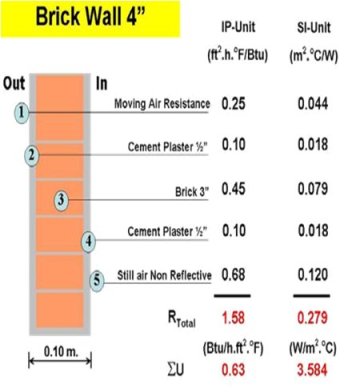
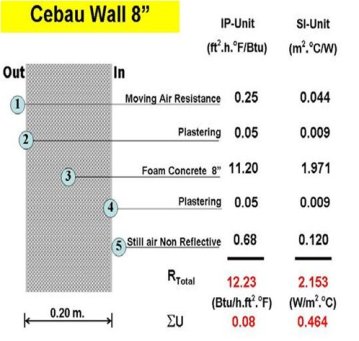
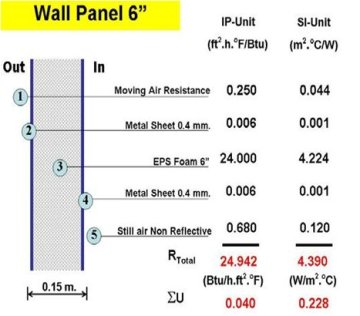
This paper shows an example of a comparison of cooling load through wall of Eco-home to typical house. Typical house’s wall use 4 inch brick. Eco-home’s wall use 8 inch Cebau or 6 inch wall panel. The U-value of these materials is shown as follows (figure 8).
 |
|
Figure 8a: U-value of 4 inch brick wall.
|
 |
|
Figure 8b: U-value of 8 inch Cebau wall.
|
 |
|
Figure 8c: U-value of 6 inch wall panel.
|
Beside wall materials, there is another important material as glazing material. People need interaction with the environment scene outside, therefore glazing material is essential for client demand. Since glazing material has allows more heat into the house, the use of more glazing must be design with careful investigation. The designer didn’t make the decision on the best performance. The use of more glazing material will result the use of more energy and may effect in lifestyle as shown in the table 3.
Table 3: Glazing material properties.
| |
|
|
|
|
|
6mm Clear
|
Green laminated
|
Green heat stop
|
|
|
single glass
|
glass
|
glass
|
|
U-value(summer)
|
1.06
|
1.06
|
0.30
|
|
(Btu/h ft2 OF)
|
|
|
|
|
SC
|
0.86
|
0.60
|
0.45
|
|
L/T
|
0.96
|
0.60
|
1.40
|
|
STC
|
29
|
30
|
34
|
|
Inside surface
|
26
|
45
|
32
|
|
temperature (OC)
|
|
|
|
|
UV Transmittance
|
86
|
0.02
|
0.005
|
Building form and surface area is explained by surface to usable ratio (S/A). Surface to usable ratio of typical house is 3, while Surface to usable ratio of eco-home is 2.
Figure 9: A comparison Surface to usable ratio (S/A).
Site and Location are impact to temperature different between inside and outside ( T). For example, an improper landscape such as concrete area exposed to the sun and not enough tree shade will increase temperature of 35OC to 39 OC or higher. When the room temperature is 25OC the temperature different is 14OC (Figure 10).
Figure 10: An improper landscape in typical house.
In contrast, Eco-home landscape is improved by growing trees for heat reduction. When the wind passes through 35OC, it will decrease the temperature around 3OC. When the room temperature is 25OC the temperature different is 7OC (Figure 11).
Figure 11: A proper landscape in Eco-home.
The Energy Efficiency Ratio (EER) or the Coefficient of Performance (COP) of mechanical equipment is another factor. The higher COP of equipment partly air conditioner, can produce cooler temperatures with less energy consumption. In this paper is compare between Typical house, which 1/COP = 0.28 and Eco-home, which 1/COP = 0.23.
This paper show example simulation of energy consumption in building that depends on wall component (figure 12).
Figure 12: Energy consumption ratio between typical house and Eco-home which use Cebau wall.
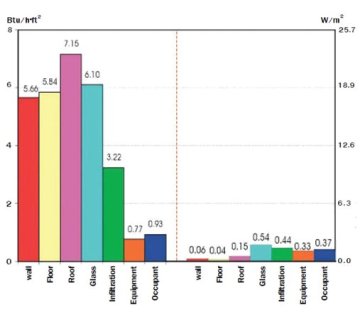
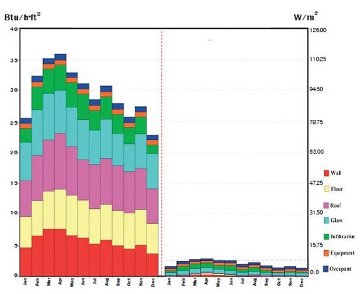
In case of using Cebau wall, Eco -home can reduce energy around 30 times from typical house. It can easily improve home performance by change wall material from Cebau wall to panel wall. It can reduce energy around 60 times from typical house. Others cooling component (figure 13 and 14).
 |
|
Figure 13:
The comparison of the cooling load
of the Eco-home to a typical house.
|
 |
|
Figure 14:
The comparison of cooling load
of the Eco-home to a typical house.
|
Conclusion
The Eco-home is one of the answers to the economic, climate change, and energy saving today. Its performance close to Bio -solar home with provide all human comfort all day and all year round with very low energy consumption. All openings protect UV ray from outside. Construction budget is less. For 200 square meters of usable area, Eco-home costs only 2 million baht while typical house costs 3 million baht. Construction time reduces to 56 days compared to 256 days of typical house. It uses most recyclable materials such as EPS foam, steel, and glass. The energy consumption rate is very low which about 5 times less than typical one (figure 18) . For wall materials and construction details, it reduces energy consumption as much as 30 times compared to typical wall section as light weight masonry, brick, etc. After small amount of energy budget required in Eco-home, then, renewable energy sources are feasible. Finally, the idea of carbon neutral is possible. It means that renewable energy can support all loads. Furthermore, it would provide energy to the grid or neighbor.
Figure 15: Cumulative energy cost in 30 year.
Since it consumes low energy, it can use renewable energy such as solar power. Eco-home’s roof area is enough for solar cell area requirement. Typical house requires more 19 house’s roof area. This concept is trended to be Carbon neutral.
Figure 16: A comparison roof area requirement for solar cell of Eco-home to typical house.
Discussion
This sustainable design concept can apply to the conventional (or typical) one-storey house. Compare to the typical one -storey house with old design concept, this new Eco-home concept will give less complicated problems and get more good performances in many ways.
Figure 17: Diamond home at DNA resort and spa Khao Yai.
The form and space of both Diamond-home and Igloo-home are developed from the new sustainable Eco-home concept.
Becoming the Bio-sphere by reduce the foot print area of the Igloo-home. The result of doing that will minimized the building to surface area ratio (S/A).
Figure 19: Bio-sphere at DNA resort and spa Khao Yai. (copyright by GG Advantage., Co. Ltd.)
Acknowledgement
I am heartily thankful to my researcher teams, Assoc. Prof. Dr. Vorasun Buranakarn, Jayanin Chitranukroh, Ph.D., Suteewan Lohasuwan, Ph.D., Miss Usanee Mingvimol, and Mr. Anusitt Sirirachtaphat of center of excellence building and environmental technology, school of architecture, Chulalongkorn University. It is a pleasure to blessings those who made this research possible.
Reference
American Society of Heating, Refrigerating and Air Conditioning Engineering. (2001). 2001 ASHRAE Fundamentals Handbook IP Edition. Atlanta Geogia: (n.p.).
Boonyatikarn, S. (2004). Bio-solar home: It is powered by the sun. Bangkok: Chulalongkorn University Press.
Boonyatikarn, S. (1999). Energy Conservation House Technique for Better Quality Life. Bangkok: Chulalongkorn University Press.
Buranakarn, V. (2009). A New Paradigm Shift Design for Global Warming Solution. World Alternative Energy Sciences Expo (WAESE), March 5-8th, 2009, Thailand.
Buranakarn, V. (2008) . The Paradigm Shift for the Next Generation. PAM Sarawak Chapter Design Forum: Green Building - The Way to Sustainable World, Malaysia.