How sustainable can smart and green buildings be?
Dr. Jan-Olof Drangert, Linköping University, Sweden and Vatema Consultant
 |
Buildings impact the environment when they are being built and while inhabited. Even when they are pulled down they contribute a large part of landfill material (40%). With an estimated increase in urban population in the present century from 3 to 8.5 billion people (OECD, 2013) and twice as many residences are to be built compared to what existed in the year 2000.
The building industry exercises a dominant influence on carbon dioxide emissions and all other kinds of negative impacts on the environment and human health. It is in this perspective that the idea of green or smart buildings has grown strong.
|
The rapidly growing housing market creates demand for shelter, 24/7 supply of water, clean lakes and streams, clear stormwater drains, and proper solid waste collection according to media. However, there may be weak demand for sustainable housing that reduces environmental impacts of input material such as locally made bricks, water-saving toilets and faucets, energy-saving heating and cooling, vegetable gardens and rainwater harvesting is generally wanting. The question is whether the building industry can deliver on this anyway?
 |
Another crucial sustainability aspect deals with reuse and recycling of used products. Such measures are becoming more challenging because household products contain ever more chemical substances. Altogether, an ordinary household may buy, use and dispose of products that contain more than 30 000 different chemical substances (industry uses some 150,000 different substances according to ECHA, 2007). No waste water treatment plant can treat such polluted water to a reuse standard or produce a sludge that safely can be put on farm fields.
Ways to address pollution problems include reduced use of waste-producing products, exchange of toxic substances in food and other household products with degradable substances, and reduced mixing of waste streams in favour of recycling single loops. The building industry can contribute substantially to all three sets of measures.
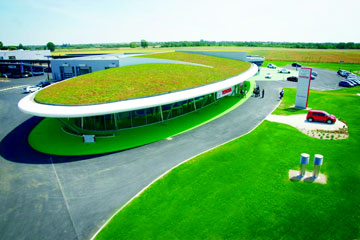
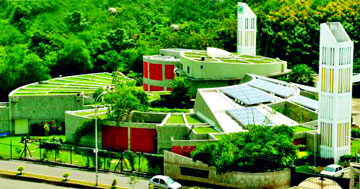
Various sustainable houses are being built globally, and some are found in Bangalore. Energy is produced by the sun and reduced demand is achieved by LED lighting, solar-based cooling, natural ventilation, low-energy washing machines, fridges etc. Solid waste is sorted at household level and waste dealers make sure that what can be reused is sent to recycling companiesor for composting.
 |
As for supply of water, there are three major sources: harvested rainwater, groundwater and recycled water. As mentioned earlier, used water should not be mixedin order to facilitate treatment of the various fractions - and reuse. A simple recommendation is to not mix stormwater with sewage; industrial with household wastewater; toilet water with grey water; and - if feasible - faecal matter with urine. The nutrient-rich water from toilets and kitchen sinks can be treated and reused in gardens and on farms. Urine is a perfect fertiliser that only requires some storage before application on soil, whereas faecal matter requires storage for a year before being safe as a soil conditioner (WHO, 2006). Water from washing machines and showers is polluted with persistent and toxic substances and can only be safely recycled if the household uses environmentally friendly washing products.
A single house with such water and energy installations does not require much extra work by the residents, while they remain almost self-reliant of water and energy. Most of the services to increase sustainability are built into the house as indicated in the Figure below. Flat roofs, a water sump under the house and a recharge well in the garden for excess rain water are constructed together with the house. Vegetable gardens, bushes and fruit trees can be watered with nutritious recycled water. Little storm water and waste water leave the compound.
 |
Also condominium complexes can be made truly sustainable. In Bangalore, there are almost one hundred housing complexes with a sewage treatment plant in the basement treating the water so it can be used for toilet flushing and gardening (colourless and with no odour). If the treated water is also allowed to pass through a small wet land, this polished water can recharge the ground water (Figure below). After such elaborate treatments, the resulting ground water can be withdrawn and used for all household purposes. If residents are suspicious of the water quality, they can pre-treat the drawn water with ozone or other methods. Recycled water and water harvested on roofs and gardens provide enough water for a decent supply without mining ground water (See figure where L = litre per person per day) if all water-saving devices are in place. There is no more need for hiring a water tanker.
The chosen treatment methods depend on the garden area available, and the wet land can be replaced by a more technical and compact treatment, while ground water remains an unconfined storage (Drangert et al., 2010). Space is not a given, however, as shown by the following two examples.
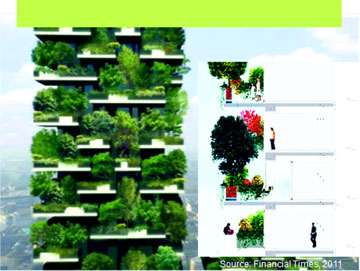
In Milan, Italy, high-rise buildings with large-size trees on the balconies are being built in an affluent neighbourhood. Residents can produce vegetables, fruits and berries for their own consumption just like any roof garden. Also, recycled treated water is used for irrigation and fertilisation. The second example pushes the limit of an existing city with jammed streets. The three pictures show the space that 80 people require if they travel by car, motor cycles or bus or walk. If public transport is being provided, most of the street is available for other activities. The street could be turned into a long garden providing fresh air to pedestrians as well as residents.
The investment cost in sustainable single-house and housing complexes above is just a few percentages higher than a conventional building. That extra cost will be recovered from lower water bills in five to ten years depending on how subsidized the communal water is. In cities with erratic water supply residents are likely to bear that time-bound extra cost for the benefit of 24/7 supply. After ten years the residents will earn money each year compared to a conventional water connection. Their energy bill will also be drastically reduced and pay for the extra investment in solar panels etc. Frontrunners among building companies can make a fundamental contribution to improved urban living and resource saving with negligible risk taking. Now is the time to reap the fruits of an unprecedented urban building boom.
References: