Limit State Of Durability As Applied To Structural Steel – A Brief Review
Dr. M. C. Nataraja , P. G. Dileep Kumar
 |
Steel structures are designed so that they can satisfy requirements regarding safety, serviceability, durability and aesthetics throughout their design service life. Present design procedures regarding steel structures required by national or international codes and standards such as BIS, BS, AS/NZ, Euro codes, etc. are predominantly based on strength principles and limit state formulation. The durability aspect is a natural extension of the classical resistance verification where deterioration effects are normally neglected. The reliability is assessed through the given performance that must be delivered within the design service life, the so-called performance-based design. This approach can be adopted for a performance based on service life design. In the recent years design is related to durability through the analysis of corrosion, resistance to sulphate attack, improved abrasion resistance, etc. In this paper a brief review of literature and some recommendations are presented referring to the design of steel structures aiming to attain greater durability.
1. Introduction
The steel structure is considered as durable in the actual environment as long as its function is acceptable. Durability is the capability of maintaining the serviceability of a structure over a specified time, or a characteristic of the structure to function for a certain time with required safety and corresponding characteristics, which provide serviceability. Structures contain elements that can last more than 100 years such as foundations, walls and floor slabs, while on the other hand there are components that need frequent replacing. The durability of a structure is its resistance against the actions from the environment surrounding the structure. However, some structures, depending on their quality and environmental aggressiveness, may not have satisfactory durability and may fail prematurely.
Such failures currently amount to significant percentage (about 5 to 10 %) of the total investment in new buildings and structures. These failures not only represent important cost considerations, they also have an environmental burden associated with them. Structures often deteriorate because not enough attention is given during the design stage and most standards for structural design do not cover design for service life. Designing for durability is often left to the structural designer or architect who may not have the necessary skills, and result in failure, incurring high maintenance and repair costs. Knowledge of the long-term behaviour of materials, building components and structures is the basis for avoiding these failures. [1-6]
1.1 Durability as per IS: 800-2007
A durable steel structure as per IS: 800-2007 [7] is one that performs desired function in the working environment under the anticipated exposure condition during its service life, without deterioration of the cross sectional area and loss of strength due to corrosion. The material used, the detailing, fabrication, erection and surface protection measures should all address the corrosion protection and durability requirements. Requirements for durability depends on shape, size and orientation of members, connections and their details place a very important role in defining the durability of steel.
The design, fabrication and erection details of exposed structures should be such that good drainage of water is ensured. Standing pool of water, moisture accumulation and rundown of water for extended duration shall be avoided. The details of connections should ensure that
a) All exposed surfaces are easily accessible for inspection and maintenance; and
b) All surfaces, not so easily accessible are completely sealed against ingress of moisture.
Exposure Condition: As per IS: 800-2007 [7], the exposure condition is classified as follows based on general environment. The general environment, to which a steel structure is exposed during its working life, is classified into five levels of severity, as given in Table 1.
|
Sl. No.
|
Environment conditions
|
Exposure Conditions
|
|
1
|
Mild
|
Surfaces normally protected against
exposure to weather or aggressive
condition as in interior of buildings,
except when located in coastal areas
|
|
2
|
Moderate
|
Structural steel surfaces:
a) exposed to condensation and rain
b) continuously under water
c) exposed to non-aggressive soil / groundwater
d) sheltered from saturated salt air in coastal area
|
| 3 |
Severe
|
Structural steel surfaces:
a) exposed to severe frequent rain
b) exposed to alternate wetting and drying
c) severe condensation
d) completely immersed in sea water
e) exposed to saturated salt air in coastal area
|
|
4
|
Very severe
|
Structural steel surface exposed to:
a) sea water spray
b) corrosive fumes
c) aggressive sub soil or ground water
|
|
5
|
Extreme
|
Structural steel surfaces exposed to:
a) tidal zones and splash zones in the sea
b) aggressive liquid or solid chemicals
|
Table1- Environmental Exposure Conditions
1.2 Major durability problems
Following three factors are the main durability problems in steel structure. Corrosion is the serious problem in all steel structures which need to be addressed separately.
Abrasion: IS: 800-2007 is salient about abrasion and suggests specialist literature review for durability of surfaces exposed to abrasive action as in machinery, conveyor belt support system, storage bins for grains or aggregates.
Exposure to sulphate attack: As per IS; 800-2007, appropriate coatings may be used when surfaces of structural steel are exposed to concentration of sulphates (SO3) in soil, ground water, etc. When exposed to very high sulphate concentrations of more than 2 percent in soil and 5 percent in water, some form of lining such as polyethylene, polychloroprene sheet or surface coating based on asphalt, chlorinated rubber, epoxy or polymethane material should be used to completely avoid access of the solution to the steel surface.
2. Corrosion
2.1 The Corrosion Process
The corrosion of steel can be considered as an electrochemical process that occurs in stages. Initial attack occurs at anodic areas on the surface, where ferrous ions go into solution. Electrons are released from the anode and move through the metallic structure to the adjacent cathodic sites on the surface, where they combine with oxygen and water to form hydroxyl ions. These react with the ferrous ions from the anode to produce ferrous hydroxide, which itself is further oxidised in air to produce hydrated ferric oxide (i.e. red rust.) The sum of these reactions can be represented by the following equation:
Fe + 3O2 + 2H2O = 2Fe2O3H2O
(Steel) + (Oxygen) + (Water) = Hydrated ferric oxide (Rust)
However, after a period of time, polarisation effects such as the growth of corrosion products on the surface cause the corrosion process to be stifled. New, reactive anodic sites may be formed thereby allowing further corrosion. In this case, over long periods, the loss of metal is reasonably uniform over the surface, and this is usually described as 'general corrosion'. A schematic representation of the corrosion mechanism is shown (right).
The corrosion process requires the simultaneous presence of water and oxygen. In the absence of either, corrosion does not occur.
2.2 Types of Corrosion
Bimetallic Corrosion
When two dissimilar metals are joined together and in contact with an electrolyte, an electrical current passes between them and corrosion occurs on the anodic metal. Some metals (e.g. stainless steel) cause low alloy structural steel to corrode preferentially whereas other metals (e.g. zinc) corrode preferentially themselves, thereby protecting the low alloy structural steel. The tendency of dissimilar metals to bimetallic corrosion is partly dependent upon their respective positions in the galvanic series. The further apart the two metals in the series the greater the tendency.
Another aspect that influences bimetallic corrosion is the nature of the electrolyte. Bimetallic corrosion is most serious for immersed or buried structures, but in less aggressive environments e.g. stainless steel brick support angles attached to mild steel structural sections, the effect on the steel sections is minimal. No special precautions are required in most practical building or bridge situations. For greater risk situations, gaskets, sleeves and similar electrically insulating materials should be used. Alternatively the application of a suitable paint system over the assembled joint is also effective. Microbiological Corrosion
|
Pitting Corrosion
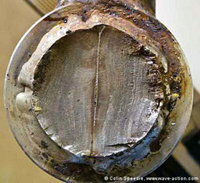
If corrosion attack on anodic metal surface continues to make deep pit instead of being stifled, the corrosion is known as pitting corrosion.
Crevice Corrosion
Crevice is formed on the steel surface by welding, debris etc. Presence of oxygen in the crevice initiates corrosion in steel. After the initiation, entrance of crevice becomes cathodic and steel surface acts as anode. As a result, corrosion rate becomes faster.
|
 |
When steel surface is in contact with soils and water, as a result of microbiological activities, corrosion occurs at steel surface. Some organisms promote supply of oxygen needed for corrosion in addition to destroying protective coating and corrosion inhibitors present at steel surface.
2.3 Factors affecting corrosion
Humidity
Humidity or time of wetness is the period, which a metallic surface is covered by adsorptive and/or liquid films of electrolyte that are capable of causing atmospheric corrosion. The wetting surface is caused by many factors, for example, dew, rainfall, melting snow and a high humidity level. The length of time, when the relative humidity is greater than 80% at a temperature greater than 0°C is used to estimate the calculated time of wetness of corroding surfaces.
Pollution
Corrosion of steel is approximately proportional to the of sulphur pollution present in the air, mostly in industrial environment and quantity of chlorides present in marine atmosphere.
2.4 Corrosion repair
There are many factors that affect the type, speed, cause, and seriousness of metal corrosion. Some of these corrosion factors can be controlled; others cannot. Preventive maintenance factors, such as inspection, cleaning, painting and preservation, are within the control of the operating activity. When you first find corrosion on equipment or a structure, the first step you take should be the safe and complete removal of the corrosion deposits or replacement of the affected part. Whether you remove the corrosion or replace the part depends upon the degree of corrosion, the extent of damage, the capability to repair or replace, and the availability of replacement parts. Any parts that have been damaged by corrosion should be replaced if continued use is likely to result in structural failure.
Areas to be treated to eliminate corrosion deposits must be clean, unpainted, and free from oil and grease. Chips, burrs, flakes of residue, and surface oxides must be removed. However, be careful to avoid removing too much of the uncorroded surface metal. Corrosion deposit removal must be complete. Failure to clean away surface debris permits the corrosion process to continue even after the affected areas have been refinished. When corrosion is present, any protective paint films must first be removed to ensure that the entire corroded area is visible. After you remove corrosion, the extent of damage must be assessed. It is at this point that you determine whether to repair or replace the affected part or to perform a corrosion correction treatment. The correction treatment involves neutralizing any residual corrosion materials that may re- main in pits and crevices, and restoring permanent protective coatings and paint finishes.
2.5 Corrosion Protection
Corrosion can be controlled by maintaining a dry environment using suitable moisture barriers or drying agents. Clean, dry metals do not corrode. Therefore, when moisture and dirt are permanently removed from metal surfaces, the tendency of such surfaces to corrode is usually eliminated. Thus, it follows that the major problem in the prevention of corrosion consists of adequately removing moisture and dirt from the surface of the metal to be protected and covering these surfaces to prevent recontamination. Consistent preventive maintenance is the most practical method of controlling metal corrosion. Maintenance such as cleaning, painting, and preservation shows great savings in labour and materials by eliminating costly repairs and replacements required when corrosion has been permitted to go un arrested.
To effectively remove oil, grease, dirt, and other undesirable foreign deposits, you should use certain cleaning agents, such as soaps, solvents, emulsion compounds, and chemicals. When you work with these agents, you should follow the correct method and sequence of procedure in applying them. You also must follow the accepted safety regulations and health precautions in the use and handling of the various cleaning agents. The important factors bearing on the choice of cleaning materials are the type and surfaces to be cleaned, such as painted or unpainted surfaces, and whether they are exterior or interior parts. Uses of Paint To prevent corrosion of metal (or deterioration of wood surfaces), you should repaint damaged or worn surfaces as soon as practical. Repaint no more often than is necessary for preservation. In the Navy, paint is used primarily for the preservation of surfaces. It seals the pores of wood and steel, arrests decay, and helps prevent the formation of rust. Paint also serves a variety of other purposes. It is valuable as an aid to cleanliness and sanitation, both because of its antiseptic properties and because it provides a smooth, washable surface.
The cost effective corrosion protection of structural steelwork should present little difficulty for common applications and environments if the factors that affect durability are recognized at the outset. This note aims to give specifiers an insight into the factors involved. In dry heated interiors no special precautions are necessary. Where precautions are required modern durable protective coatings are available which, when used appropriately, provide extended maintenance intervals and improved performance.
2.6 Painting
Painting is the principle method of protecting structural steelwork from corrosion. Paints are made by mixing, pigments (the coloured part), binders (the film forming component) and the solvent (which dissolves the binder). Paints are usually applied one coat on top of another and each coat has a specific function or purpose.
The primer is applied directly onto the cleaned steel surface. Its purpose is to wet the surface and to provide good adhesion for subsequently applied coats. In the case of primers for steel surfaces, these are also usually required to provide corrosion inhibition.
The intermediate coats (or undercoats) are applied to ‘build’ the total film thickness of the system. Generally, the thicker the coating the longer the life and this may involve the application of several coats.
The finishing coats provide the first line of defence against the environment and also determine the final appearance in terms of gloss, colour, etc.
Hot dip galvanizing
The most common method of applying a metal coating to structural steel is by hot-dip galvanizing. Galvanizing process involves the following stages:
- The cleaned steel is immersed in a fluxing agent to ensure good contact between the steel and zinc during the galvanizing process.
- The cleaned and fluxed steel is dipped into a bath of molten zinc at a temperature of about 450°C. At this temperature, the steel reacts with the molten zinc to form a series of zinc/iron alloys integral with the steel surface.
- As the steel work piece is removed from the bath, a layer of relatively pure zinc is deposited on top of the alloy layers.
As the zinc solidifies it usually assumes a crystalline metallic lustre, often referred to as ‘spangling’. The thickness of the galvanized coating is influenced by various factors including the size and thickness of the work piece, the steel surface chemistry and the surface preparation of the steel.
Weathering Steels
Weathering steels are high strength, low alloy weldable structural steels that possess good weather resistance in many atmospheric conditions without the need for protective coatings. They contain up to 2.5% of alloying elements, e.g. chromium, copper, nickel and phosphorous. On exposure to air, under suitable conditions, they form an adherent protective rust patina. This acts as a protective layer that, with time, causes the corrosion rate to reduce until it reaches a low terminal level, usually between 2-5 years.
2. 7 Key Points
- In dry heated interiors no special precautions are necessary.
- The corrosion of steel can be considered as an electrochemical process
- For steel to corrode it is necessary to have the simultaneous presence of water and oxygen.
- The principle factors that determine the rate of corrosion of steel in air are the time of wetness and the presence of atmospheric pollution.
- The prevention of corrosion should therefore be taken into account during the design stage of a project.
- Painting is the principle method of protecting structural steelwork from corrosion.
- Hot dip galvanizing is the most common method of applying a metal coating to structural steel
- Weathering steels are high strength, low alloy weldable structural steels that possess good weather
3. Australia and New Zealand Specifications
| AS /NZS 2312 [8] tabulates a number of coating systems which can be selected relative to the life span of the coating system to its first major maintenance period. This is a significant consideration. AS/NZS 2312 also provides general design principles and detailing of connections to eliminate inaccessible corrosive pockets. Durability periods in AS /NZS 2312 relate to considerations of the “coating system life to the first major maintenance period”. These are; Short term 2-5 years, Medium term 5-10 years, Long term 10-15 years, Very long term 15-25 years and Extra long term 25 plus years. AS/NZ 2312 relies on Inspection regimes being in place to respond to the performance of the coating system as the periods stated are not guarantees, but rather an averaged anticipated period under ideal conditions having regard to the correct coating application process. Refer Table 2 for details. |
 |
|
|
Coating Type
|
System
Designation
|
Thick-ness
|
Durability Period
|
| 1 |
Metal Spray Coating
|
TSZ100
|
100um
|
5-15 years
|
| 2 |
Hot dipped galvanising
|
HDG900
|
125um
|
10-15 years
|
| 3 |
Hot dipped galvanising plus paint
|
HDG600
|
200um
|
15-25 years
|
| 4 |
Pre galvanised strip (tubes)
|
ZB100/ 100
|
14um
|
Not recommended
|
Table 2 Coating system and its durability
The Table 2 clearly shows that owners can be faced with high costs for providing maintenance to structural steel where a lower durability protective coating has been specified in the design. Refer to AS /NZS 2312 for more details. Therefore matching a coating system to the environment and then the period to the first major maintenance period is an important fact to be specified in the building design.
4 BIS code requirements
4.1 Corrosion Protection Methods
The methods of corrosion protection are governed by actual environmental conditions as specified in IS 9077 and IS 9172 [9, 10]. The main corrosion protection methods are given below:
a) Controlling the electrode potential,
b) Inhibitors, and
c) Inorganic/metal coatings or organic/paint systems.
Surface Protection
In the case of mild exposure, a coat of primer after removal of any loose mill scale may be adequate. As the exposure condition becomes more critical, more elaborate surface preparations and coatings become necessary. In case of extreme environmental classification, protection shall be as per specialist literature. Table 2 gives guidance to protection of steelwork for different desired lives.
(a) Coating System Desired Life in Different Environments (In Years)
|
Atmospheric Condition/
Environmental class
|
Coating System 1
|
Coating System 2
|
Coating System 3
|
Coating System 4
|
Coating System 5
|
Coating System 6
|
Normal Inland
(Rural and Urban areas), mild |
12 years |
18 years |
20 years |
About 20 years |
About 20 years |
Above 20 years |
Polluted Inland
(High airborne sulphur dioxide),
moderate |
10 years |
15 years |
12 years |
About 18 years |
15-20 years |
Above 20 years |
Normal Coastal
(As normal inland plus high
airborne salt levels), severe |
10 years |
12 years |
20 years |
About 20 years |
About 20 years |
Above 20 years |
Polluted Coastal
(As polluted Inland plus
high airborne salt levels),
very severe , extreme |
8 years |
10 years |
10 years
|
About 15 years |
15 - 20 years
|
Above 20 years |
(b) Specification for Different Coating System,(i) Shop Applied Treatments
|
Coating System
|
1
|
2
|
3
|
4
|
5
|
6
|
|
Surface Preparation
|
As necessary
|
As necessary
|
No site treatment
|
As necessary
|
No site treatment
|
As necessary
|
|
Primer
|
Touch in
|
Touch in
|
-
|
-
|
-
|
Touch in
|
|
Intermediate Coat
|
-
|
Modified Alkyd Micaceous Iron Oxide 50 mm
|
-
|
Touch In
|
-
|
High-build Micaceous Iron Oxide Chlorinated Rubber Micaceous 75 mm
|
|
Top Coat
|
High-build Alkyd Finish 60mm
|
Modified Alkyd Micaceous
Iron Oxide 50 mm
|
-
|
High-build Chlorinated Rubber
|
-
|
High-build Iron Oxide Chlorinated Rubber 75 mm
|
(b) Specification for Different Coating System, (ii) Site Applied Treatments
|
Coating
System
|
1
|
2
|
3
|
4
|
5
|
6
|
|
Surface Preparation
|
Blast Clean
|
Blast Clean
|
Blast Clean
|
Blast Clean
|
Girt Blast
|
Blast Clean
|
|
Pre-fabrication primer
|
Zinc Phosphate Epoxy 20 mm
|
2 pack Zinc-rich Epoxy 20 mm
|
-
|
2 pack Zinc-rich Epoxy 20 mm
|
-
|
Ethyl Zinc Silicate 20 mm
|
|
Post fabrication primer
|
High-build Zinc Phosphate modified Alkyd
60 mm
|
2 pack Zinc-rich Epoxy
20 mm
|
Hot tip Galvanise
85 mm
|
2 pack Zinc-rich Epoxy 25 mm
|
Sprayed Zinc or Sprayed Aluminium
|
Ethyl Zinc Silicate 60 mm
|
|
Intermediate coat
|
-
|
High-build Zinc Phosphate 25 mm
|
-
|
2 pack Epoxy Micaceous Iron oxide
|
Sealer
|
Chlorinated Rubber Alkyd 35 mm
|
|
Top coat
|
-
|
-
|
-
|
2 pack Epoxy Micaceous Iron Oxide 85 mm
|
Sealer
|
-
|
Steel surfaces shall be provided with at least one coat of primer immediately after its surface preparation such as by sand blasting to remove all mill scale and rust and to expose the steel. Steel without protective coating shall not be stored for long duration in outdoor environment.
Surfaces to transfer forces by friction as in HSFG connections shall not be painted. However it shall be ensured that moisture is not trapped on such surfaces after pre-tensioning of bolts by proper protective measures.
Members to be assembled by welding shall not be pre-painted at regions adjacent to the location of such welds. However, after welding, appropriate protective coatings shall be applied in the region, as required by the exposure conditions. If the contact surfaces cannot be properly protected against ingress of moisture by surface coating, they may be completely sealed by appropriate welds. Pre-painted members shall be protected against abrasion of the coating during transportation, handling and erection.
4.2 Special Steels
Steels with special alloying elements and production process to obtain better corrosion resistance may be used as per specialist literature.
5. References
- Pantelis, D. I., Bouyiouri, E., Kouloumbi, N., Vassiliou, P., and Koutsomichalis, A. (2002). Wear and corrosion resistance of laser surface hardened structural steel, Surface and Coatings Technology, 161(2), 125-134.
- Melchers, R. E. (2005). The effect of corrosion on the structural reliability of steel offshore structures, Corrosion Science, 47(10), 2391-2410.
- Mattsson, E. (1982). The atmospheric corrosion properties of some common structural metals- A comparative study, Master Performance, 21(7), 9-19.
- Brockenbrough, Roger L., and Frederick S. Merritt. Structural steel designer's handbook. New York, McGraw-Hill, 1999.
- Li, Chun Qing (2000). Corrosion initiation of reinforcing steel in concrete under natural salt spray and service loading? Results and Analysis." ACI Materials Journal, 97(6), 223-229
- Chandler, Kenneth A., and Derek A. Bayliss. Corrosion protection of steel structures. Elsevier Applied Science Publishers, 1985.
- IS: 800-2007, Code of Practice for General Construction in Steel, Bureau of Indian Standards, (BIS) (2007), New Delhi, India.
- AS/NZS 2312 “Guide to the Protection of Structural Steel against Atmospheric Corrosion by the Use of Protective Coating.
- IS: 9077-1979, Code of practice for corrosion protection of steel reinforcement in RB and RCC construction.
- IS: 9172-1979, Recommended design practice for corrosion prevention of steel structures.
|
|
| Shape and arragements of structural members to control corrosion |
Acknowledgement: This article was presented by Dr. M. C. Nataraja , Professor, Department of Civil Engineering, Sri Jayachamarajendra College of Engineering at the National Seminar on Steel Structures- Steelcon, held at Mysore on 26th and 27th of April, 2013; Contact: nataraja96@yahoo.com. Co-Author -P.G. Dileep Kumar, Assistant Professor, Department of Civil Engineering, Government Engineering College, Kozhikode, INDIA