An outline on India’s realty sector by JLL
Mr. Anuj Puri, Chairman & Country Head, JLL India
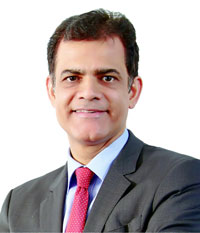 |
Mr. Anuj Puri, Chairman & Country Head, JLL India, a professional services and investment management company specializing in real estate shares with Built Expressions about his professional voyage and experiences of his recent participation at Davos World Economic Forum |
You played a significant role in the merging of TCM with global real estate giant JLL and now you are heading JLL India. How has been the journey? (Career journey in the real estate industry)
I’ve been in the real estate game for over 20 years, and it was not always a cake-walk. The Indian real estate market is not a steady industry, and I learned quite quickly that this is not a game for those who are prone to motion sickness.
After a longish stint in chartered accountancy and loss adjustment firms, I assumed directorship of the Delhi office for TCM in 1997. TCM is how we fondly referred to Trammell Crow Meghraj Property Consultants Pvt. Ltd. – which was the most successful real estate consultancy in India back then. I became Managing Director of TCM in 1999. It had around 1000 staff members and operated from 10 offices across the country.
In June of 2007, I steered the merger of Trammell Crow Meghraj – with a global real estate giant called Jones Lang LaSalle. It was a merger of equals – and one of my proudest achievements to date. Both firms brought an equal amount of business and margin in the combined entity. The merger gave us a huge edge over rival real estate consultancy firms - and we have maintained this edge ever since. Running a real estate business was never easy, but the whole ballgame REALLY changed for me after that.
For me, the learning curve was steep, sudden, breathless and without rest-stops - and it never ended. Learning was and continues to be literally on the fly, because neither the Indian real estate market nor its stakeholders have ever been very predictable. But the learning process was as exhilarating as it was challenging. I would certainly not wish to ever have to revisit those early years again – today, I prefer the security of experience over the adrenaline of discovery - but they provided me with the foundation on which I stand to the present day.
Heading a global firm like JLL demands certain specialized skill sets. How are you equipped to steer JLL India?(Experience in the real estate market and about JLL)
I am specialized in multi-disciplinary advisory and transactions ranging from real estate to social development projects. My field of expertise includes planning, undertaking demand assessment studies and transaction services, including marketing strategies based on technical real estate market analysis, feasibility studies, program requirement derivation and fund and investor sourcing. I am responsible for the overall direction, strategy and growth of the India operations of JLL, which is the largest premier real estate services company in India with an annual business turnover in excess of INR 800 crores, and oversee a team of over 6000 employees across 11 cities in India.
Currently, Indian real estate market is reviving itself. What are your comments on the present scenario of the country’s realty market? (India as an emerging market for real estate)
The property market in India has always seen typified by unorganized and fragmented growth. However, over the past decade we have seen a big shift in the fundamental growth drivers. This has attracted private equity players and other real estate funds from abroad. In addition, existing and new players in the development business are eyeing viable and profitable projects. The market continues to grow in all major markets of the country.
In commercial real estate, Mumbai, Pune, Delhi, Bangalore, Chennai and Hyderabad have attracted the interest of IT/ITES companies, who are either setting up their bases or looking for expansion. The suburban localities in these cities are experiencing a high level of activity due to easier availability of land, construction of large floor plates; offer of built-to-suit facilities and at lower rental.
Things are also looking up for residential real estate once again. Post the arrival of a new government, the Indian economy is once again poised to reach near-normal rate of growth. As a result, residential property sales will also revive. Recent trends and the foreseeable outlook suggest that the volume of sales will rise as developers focus on mid-segment and affordable homes. On the other hand, increased focus on affordable to mid-segment housing would help bring the average prices down, hence retaining the value of properties.
Your views on comparison of Indian real estate with global markets…… (Current real estate markets - global v/s Indian)
India has a long way to go when compared to more developed countries. This is true in all respects and includes the real estate sector, as well. However, few developed countries promise the kind of growth that a young and rapidly emerging country like India does. The established markets of developed economies are about stability, while the India story has and will continue to be about growth.
The newly elected government is giving a lot of thrust to infrastructure development thus growth of real estate too. What are your expectations from the new government? (Expectations from the new government at the centre)
The new government promises to aggressively promote affordable housing. Property is once again going to become the most popular investment option, as there will be significant appreciation in real estate prices on the heels of higher demand in the coming years. With the easing of regulations, developers are expected to speed up the construction process, providing relief to buyers who have already invested.
The big names of the Indian industry have welcomed the new government with a hope that it will bring the economy back on track and raise the currently plummeting GDP to 8-9% in the coming fiscal. The new government at the centre is expected to infuse life in the existing policy paralysis in the country by removing the major bottlenecks that are deterring growth.
India has a long way to go when compared to more developed countries. This is true in all respects and includes the real estate sector, as well. However, few developed countries promise the kind of growth that a young and rapidly emerging country like India does. The established markets of developed economies are about stability, while the India story has and will continue to be about growth.
Share your experiences of the Davos World Economic Forum 2014 (Experiences at the Davos World Economic Forum)
The Davos summit was a unique opportunity to get insight into key issues shaping the global economies, and therefore also the Indian economy. It was a gathering of more than 3,000 of the world’s most influential leaders, dignitaries, CEOs, government officials and academics, who debated the theme ‘The Reshaping of the World: Consequences for Society, Politics and Business.‘ India was in the limelight several times as we discussed the changing world economic order. It was an opportunity to look in the future and see a new India unfolding - a India fits very well into the concept of a reshaped world. India has an important place in the larger global picture, and at the World Economic Forum 2014 we were direct witnesses and participants in the evolution of economies like ours.