Quinta da Regaleira
UNESCO World Heritage Site, Sintra, Portugal
Bureau Built Expressions
Quinta da Regaleira is a 20th century ancient estate fully filled with sacred buildings, chapels, parks and joy. It is also popularly known as ‘The Palace of Monteiro the Millionaire’, based on the nick name of its past owner ‘Antonio Augusto Carvalho Monteiro’. The Quinta da Regaleira is recognized as the World Heritage Site by United Nations Educational, Scientific and Cultural Organization (UNESCO) under ‘Cultural Landscape of Sintra’. The giant estate includes palace, winding stairs cases, hidden paths, underground caves, unique chapels, luxurious park, old benches, lakes and fountains. One who visits for the first time would likely to enjoy the surprise routes along with secretive caves, unusual paths and holly wells. The vast place is known for Gothic, Renaissance and Manueline architecture elements and styles. It is a must watch place in Sintra city.
Sintra
Sintra is considered as a very auspicious city in Portugal. The gentle point of people, rich finish on water, historic buildings, fertile land and mild climate adds more beauty to the Sintra. The city carries strong telluric feelings, the winding way into the sea it’s proximate to the stars (the fact of being born a plain abruptly makes it look taller than it is) and appreciated by ancient trees gave the druidic civilizations saw that the sacred nature in classical antiquity was the inspiration for the name of Promontory Moon. Sintra people do follow the norms and believes even today.
The Prime Mover
The Quinta da Regaleira is a vast estate came to light in 1892 was owned by a wealthy and well educated entrepreneur Antonio Augusto Carvalho Monteiro. He was born in Rio de Janeiro in 1848, the son of Portuguese parents. He pursued his Bachelor of Laws from the University of Coimbra. Heir to a great family fortune multiplied in Brazil with a monopoly of trade cafes and precious stones. He had a passion towards reading books, visiting operas, playing musical instruments, watch collections, shells and antique lover. Also had the desire to build a grand arena surrounded by all symbols of his interests and ideologies. The Regaleira estate represented the essence of Portugal, a kind of bastion of Lusitanian. He bought this estate (owned by a wealthy merchant family from Porto awarded the title of baron) for 25 contos.
In 1942 the estate was sold to Waldemar D’Orey, he designed and carried out minor works to enable it to accommodate his large family. In 1987 Regalerira estate was owned by Japanese firm Aoki Corporation for ten years. In 1997, Sitra became World Pa-Timonium classified city. City hall takes the valuable heritage buildings and gardens. In 1998 the estate was re-constructed and finally opened for public in 1998 and bega to host cultural event under the in-charge of Sintra government. The same year in the month of August, the Portuguese Ministry of Culture classified the estate as "public interest property".
The Master Mind
The architect Luigi Manini (1848-1936) a young talented creator has contributed his tastes and views along with Antonio Augusto Carvalho Monteiro. They both together managed just six years to complete this gorgeous beautiful place. Even till today, the belief of the people says that spirit lives on its creativity marks.
The Italian architect Luigi Manini was selected by Carvalho Monteiro to design the building structure of Regaleria. Luigi Manini had graduated from a very prestigious school of art and science. He came to Portugal in 1876 to work at Royal Theatre of Sao Carlos and La Scala and had a very good reputation during those days. His work in the construction of the Palace-Hotel Bucaco impressed Carvalho Monteiro. Carvalho Monteiro appreciated his works and liked him as good person too. They both Carvalho Monteriro and Luigi Manini not only were agreement/agreed to build Regaleria but they also shared the same philosophies and ideologies. These affinities were a plus point to work with joy to develop the project design of Regaleira Estate.
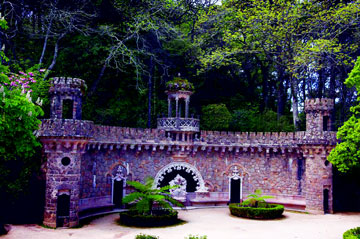 |
The structure of the building included repetition geometric lines and shape of lancet vaults and arches. In addition to the real objects and strange animals that populated the dreams and nightmare. Ruined castles, dead forests, deserted mansions, dark corridors, hidden crypts, damp underground, secret passages and barred doors through which one guesses the presence of spirits. The architect has not forgotten to save the charm of gothic style and scenery. Romanticism of the gardens and the magic of the well are the other highlights of the building.
The Gothic art impels us to look up. The building defies the laws of gravity and extends towards the sky, a succession of capitals, gargoyles and spires many almost imperceptible. A visit to Regaleira is believed that the entire universe begins with the call of the Gods porch, terrace where the statues of various divines begins are aligned along the way.
Carvalho Monteiro stands out on the building, all of it connected by ropes, knots, loops and friezes, a manifest feature the typical elements of the Manueline style. Manueline features are visible in the use of ornaments like rigging, plant elements, armillary spheres and torsos small columns, and used a number of new elements like animals and anthropomorphic species, esoteric symbols related to alchemy and Freemasonry, revealing the ideas and beliefs of Oak Monteiro.
The interior of the gardens is full of surprises contained by ponds, fountains, towers, terrace, caves and many symbolic elements. It is a romantic conception; the Gardens of Regaleira is built and extended on terraces and consisting of a mixture of plants and trees brought from various parts of the world which have been integrated harmoniously with indigenous vegetation. The walk through the gardens and the woods is by way of ascent, leaving the delicate areas and ascending to the spontaneous forest.
Regaleira Palace
The Regaleira Palace inside the estate compound shares the same name of the estate. The structure of the palace features includes Gothic, Pinnacles, Gargoyles, Capitals and an impressive octagonal tower. The palace has five floors; the ground floor consists of series of hallways connecting the living room, dining room, billiard room, and balcony and towards several staircases. The first upper floor contains bedrooms and dressing rooms. The second upper floor contains Carvalho Monteiro’s office and bedrooms of female servants. The third upper floor contains the ironing room and a smaller room with access to a terrace. Finally the basement contains male’s servent’s bedrooms, kitchen and storage rooms.
Chapels
The journey still carries ever more stunning to reach the Chapel of the Holy Trinity. Single nave, the artistic style follows the same decorative lane covers the palace’s main facade. These chapels are seated on the entrance, side entrance, wall sides and especially in the revival of Gothic and Manueline. But the chapel reveals another hidden less watchful eyes, a narrow staircase located at the entrance on the right descending spiral to the crypt. There is temple stripped of decoration with mosaic pavement covered with black and white plaid dip place in darkness.
The interior of the Regaleira chapel is richly decorated with frescoes, stained glass windows and lavish stuccoes. The frescoes contain representations of Teresa of Avila and Saint Anthony as well as other religious depictions. Meanwhile, the floor itself offers depictions of the armillary sphere of the Portuguese discoveries and the Order of Christ Cross, surrounded by pentagrams.
Gardens, lakes and tunnels
The entire four hectares of land is divided by parks, tunnels, aquarium, den like caves and artistic monuments. Decorative, symbolic, and lively structures can be found throughout the park. Two artificial lakes and several fountains were added by Carvalho Monteiro. Deep down, accentuates the dramatic charge up, Recorded in inlaid marble in pink stones, stands the great cross of the churches combined with eight pointed stars after the heraldic elements of Carvalho Monteiro. At the last level of the depth, a set of caves are seen that lead us to the outside, authentic labyrinths, the underground world and beyond perhaps populated by bats. Artificial construction galleries are advantage factors, the geological characters of granite stain the Serra de Sintra. As soon as we come out from the dark cave, the scenery inhabited by fantastic animals, waterfalls and stone passages that seem to float to the surface of the lakes. The experience of sar-paths makes a remarkable memory.
Wells
At one point of the route Regaleira estate arises as one of the most beautiful places of the forest. A cluster of rocks hiding disguised stone door. This particular door takes us to one of the most impressive sights of the fantastic initiation wells. The 27 meter deep well, these wells never served as water source. They were used for ceremonial purposes that included Tarot initiation rites. It is like an inverted tower takes us into hallow path. Every fifteen steps down the nine levels of the circular pit, it is like recreating the ritual in the descended to the depths of the earth or ascended into the sky, depending on the nature of the initiatory path chosen. The nine fold allude to the nine circles of well, the nine sections of Purgatory. The Nine heavens of Paradise consecrated Dante in the Divine Comedy.
- http://www.rotas.xl.pt/1201/a05-00-00.shtml
- http://www.gifi.pt/portal/programs/ewpview.aspx?codigo=REGALEIRA
- http://www.portugalvirtual.pt/_tourism/costadelisboa/sintra/regaleira.html
- http://www.amazfacts.com/2012/02/initiation-well-in-town-of-sintra.html
- http://wonderfulwanderings.com/monserrate-sintra-photo-essay/ [Images]
- http://portugal.bukovina.biz.ua/sintra/quintadaregaleira/ [Images]