Jurgen Mayer H, Founder, Architect of J. MAYER H. und Partner, Architekten
Eternal Aspect of Architecture
"Curiosity is, in great and generous minds, the first passion and the last" a quote by Samuel Johnson goes well with Ar. Jurgen Mayer H. His curiosity to acquaint various types of architects followed in different cultures takes him across the globe. He swears by trusting his own arguments and finding own aesthetics and suggests the same to flourishing architects to believe in multiplicity rather than on any given regulations.
His couple of visits to India has allowed him to be enthused about the long history of India's bright and broad variety of aesthetics and so the open minded curiosity of Indians and the complexity of life in different levels of intersecting. He never confines his creativity to just buildings and structures rather he experiments by designing objects and sculptors, which are showcased in museums worldwide.
Ar. Mayer was in India recently at InCITE Academy to inaugurate a themed exhibition—Block.Buster. In a chitchat interview with Built Constructions, he begins saying, "My visit to India has always been exciting and a rich learning experience." While taking us through his professional journey, he narrates how he has carved niche in architecture throughout the world.
Architectural Imprints across the World
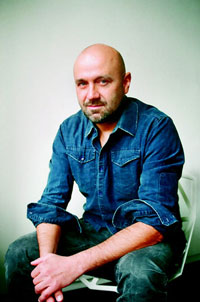 |
J. MAYER H. was founded in 1996 by Jürgen Mayer H. in Berlin. In January 2014, Andre Santer and Hans Schneider joined as partners in the firm. Jürgen Mayer H. studied at Stuttgart University, The Cooper Union and Princeton University. His work has been published and exhibited worldwide and is part of numerous collections including MoMA New York and SF MoMA and also private collections. "Our work spans from small scale residential to public buildings, commercial buildings and also infrastructure projects. We have built many structures along the highway, porter stations between different countries, small airports and police stations among other infrastructure projects," he adds.
Western world gives ample momentousness to architecture in their infrastructure projects. Architecture need not happen in luxury sect of building constructions only but it should happen in
|
public buildings and infrastructure buildings as well since they also contribute to the building culture of the location.When happens at the infrastructure level, it adds value to the city's communion with its visitors.Countries like Italy and Switzerland have given enough impetus for their building culture through sophisticated architecture. "Even Georgia had a unique vision for buildings as it was a transit country, lot of people pass through it and architecture that they witness would be an impression of the cultural criteria," he admits. He has his share of architectural work that stands out in Georgia.
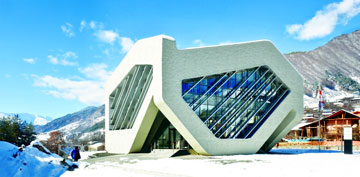
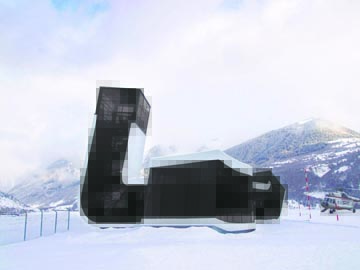
Queen Tamar Airport is a new airport building in Mestia, Georgia that was designed by him. The new built airport is part of Georgia's ambitious plans to develop tourism in Mestia. The beautiful medieval town with its stone defensive towers is part of UNESCO's list of World Heritage Sites and also famous as ski-resort. The building was designed and constructed within 3 months.
Another crucial project was House of Justice, a Civic Centre in Mestia, Georgia. It serves as a two storey civic centre for the people of Mestia, a village with a strong cultural heritage. Its concrete structure frames the spectacular landscape of the Caucasian Mountains. The building is part of an ensemble of new public buildings around the main central public plaza.
In 2009, the head of the Roads Department of Georgia commissioned Ar. Mayer to design a system of 20 rest stops for the new highway, a thoroughfare that will run through Georgia and serve as a connection between the Republic of Azerbaijan and the Republic of Turkey. Two first rest stops were completed in 2011 near Gori, a third in Lochini was finished 2012. The new rest stops are located on selected scenic viewpoints along the route and serve as activators for their area and neighbouring cities, including not only nearby a gas stations and supermarket, but also a farmers market and a cultural space for local arts and crafts.
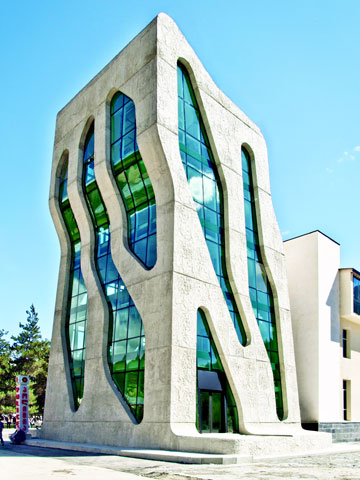 |
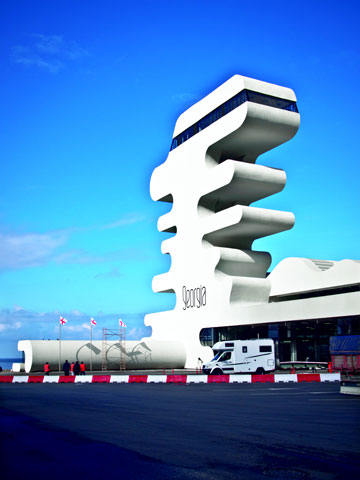
The Border Checkpoint at Sarpi of Georgia is at the shore of the Black Sea. With its cantilevering terraces, the tower is used as a viewing platform, with multiple levels overlooking the water and the steep part of the coastline. In addition to the regular customs facilities, the structure also houses a cafeteria, staff rooms and a conference room. The building welcomes visitors to Georgia, representing the progressive upsurge of the country.
Ar. Mayer came to Berlin in a time just after the German reunification in which German Democratic Republic joined the Federal Republic of Germany to form the reunited nation of Germany. When Berlin reunited into a single city, it was transforming at an incredible speed and it had the massive potential for reconstruction and new buildings. The city had lot of conservative building and it was more obsessed with reconstruction of the city that was lost. (At that time, younger generation was more interested in breaking the complexity, filling up the empty spaces and much as more of fragmented layering of history well done and making the city very unique.) However, the preference was given to homogeneous designs. At this juncture, Ar. Mayer wanted to disport his creativity that led him to reach out competitions internationally. He says, "It was difficult initially but turned out to be favourable in the long run as it became a good opportunity to reach out to competitions internationally. We have projects all over the world and built in good network. We get feedback from other cultures to our work and we can also bring our own expertise to the other cultures." In India too he is finilising on a project, about which he says too early to divulge any details.
True Synthesis
Started the firm in 1996, the first competition entry we won was in 98, since last year January I've partners in the office basically there were in the office for many years, to make office more sustainable,
 |
While speaking on his design philosophy that highlights digital data and graphics, Ar. Mayer interestingly points out that architecture and digital data that contemporary society deals with. "The way architecture creates boundaries of inside, outside, privacy, public and reality, similarly we have a frontier on sharing data with others. In a society, which is so obsessed with data and information, I see a sort of correlation between architecture and this digital information. The design here becomes a negotiation between private and public that is culminated in architectural designs. Architecture is something that inhabits us, people, one of the oldest inventions through which we can create an environment how we live. We can do that with all kind of techniques and technologies with innovative structures around us. So the technology inventions reflects how we build so we have to find an architecture that really is in response or dialogue with the technology that we are developing. Architecture is for creating spaces for communication and this communication deals with people, nature and technology, between history and ideas or visions about the future.
 |
"Metropol Parasol", the Redevelopment of the Plaza de la Encarnacíon in Seville, designed by Ar. Mayer, became already the new icon for Seville, - a place of identification and to articulate Seville's role as one of the world´s most fascinating cultural destinations. "Metropol Parasol"explores the potential of the Plaza de la Encarnacion to become the new contemporary urban centre. Its role as a unique urban space within the dense fabric of the medieval inner city of Seville allows for a great variety of activities such as memory, leisure and commerce. A highly developed infrastructure helps to activate the square, making it an attractive destination for tourists and locals alike.
The "Metropol Parasol" scheme with its impressive timber structures offers an archaeological museum, a farmers market, an elevated plaza, multiple bars and restaurants underneath and inside the parasols, as well as a panorama terrace on the very top of the parasols. Realized as one of the largest and most innovative bonded timber-constructions with a polyurethane coating, the parasols grow out of the archaeological excavation site into a contemporary landmark, defining a unique relationship between the historical and the contemporary city. "Metropol Parasols" mix-used character initiates a dynamic development for culture and commerce in the heart of Seville and beyond.
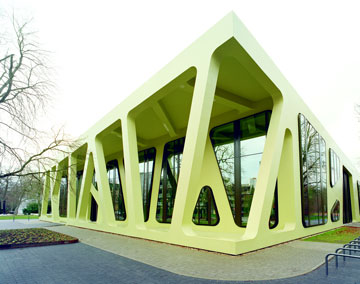 |
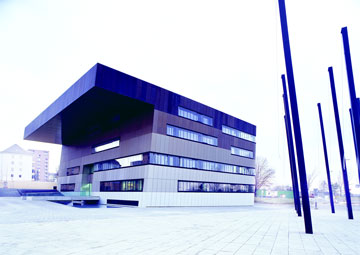
Stadthaus located at the centre of Scharnhauser Park, a former American military site next to Stuttgart airport was the first project designed by Ar. Mayer's firm. It is a multifunctional public building unifying municipal administration, civil services, a public library, an art gallery, classrooms for music lessons and evening school, a wedding room, office space, sports facilities and a multi-purpose hall. This combination of different public services generates synergetic effects provoking programmatic and visual transparency. Spatially the entire building is considered as large, open public space with inlays of certain core elements. Floating within a space for mutual or strategic communication, these enclosed boxes structure the interior layout of the building. From the main square to the panorama deck on the roof, the Stadthaus interlocks with its context through cut-outs and terraces. These open air spaces remain accessible beyond the main opening hours and therefore serve as spatial and programmatic extensions. Light and water animations are an integral part of the Stadthaus and include a subtle relationship between nature and technology. Framing the main entrance visitors will have to walk through a computer animated artificial rain dripping from underneath the flat cantilevered roof. The Stadthaus and square construct a new public building prototype by offering simultaneity of city life in real, mediated and virtual space. "These were the early steps we took that really took off my career. We were invited to go Georgia. That was the time when Georgia was competing in another scale to completely redefine public buildings on the international scale through architecture. All 12 buildings designed by us were strategically important projects to the city," he dredges up.
 |
Ar. Mayer wallops on certain challenges too along his professional journey. To manoeuvre between different languages in communication comprising clients, academia and professionals is different. The languages that we use constantly get shifting, he adds.
Architecture Beyond Buildings
His next move in the profession is to focus more on opening architecture to other disciplines including design and art. Some of his works have already been showcased in art galleries and design fairs. The innovations and feedbacks I obtain through these works occasionally have been translated to our building projects. 'Heat Seat' is innovative furniture developed by him using temperature sensitive paints. Using 'pink noise', he has created nap caps and sleeping chambers that uses subtle noise and helps the user to fall asleep. It has been exhibited in Beijing's Design Week, last year. The experiments done in such a small scale helps us to adopt for larger buildings too. For instance, insulation for a small art work was successfully integrated to a room of a building. His art works are showcased in museums throughout the world.
 |
His penchant for teaching is coupled with travelling. He has been lecturing all over the world barring a only a few countries. "I have not yet been to Alaska and South Africa," he laughs.
According to him, architecture extends beyond designing of buildings. In architecture it is very vital to work on the future performance of buildings not only ecologically but in terms of energy and waste as well. Architecture should also contribute on cultural contexts. In future generations, we can see that architecture from today has value that captured the moments of that time to witness the history. Architecture has to work on many levels. He feels that there is an application that we can find in architectural aesthetics that, from our time to give it to the next generation.
See what is happening around us, be curious, see what is available in technology, look for leads in your culture and adopt those in architecture.
Ar. Mayer on Sustainability
Sustainability of a building should not only be viewed from ecological point of context instead from social perspective as well. Different nations have different levels of arguments on green initiatives. "For example, in Germany, our laws are quite strict in terms of sustainability. Southern countries are fortunate as they can build with very thin glazing, thin walls. On the contrary our countries require insulation that involves heavy architecture. But each country has defined its own regulations based on their local climate. Continuous innovations in sustainability must happen so that we can learn something and transport techniques into projects," he signs off.