Disaster Resilient Architecture
Ar. Rakhi Kashyap
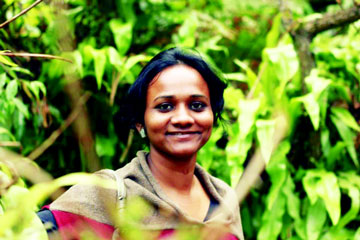
Ar. Rakhi Kashyap, Manager-Techical with SEEDS firmly believes that architecture should "Serve the safety of the community, designs will take shape likewise." In an interview with Built Constructions, she shares her aim to make an impact on communities and people on mitigating natural hazards and disasters by building disaster resilient architecture.
"We have an incredibly beautiful country with many indigenous styles of architecture. No other country has this range of beauty and interest that we have. The most important thing is that we do not destroy this, we do not take away from it and we do not foul it up. We should follow on this tradition of creating beautiful buildings in India." -Laurie Baker
Social architect is one who deals with conscious design of an environment that encourages a desired range of social behaviours leading towards some goal or set of goals. Ar. Rakhi Kashyap, Manager-Technical, SEEDS has taken on being a social architect. Gandhian philosophy and Laurie Baker's belief systems are bred-in-the-bone in her works.
Ar. Rakhi, who is set to make a difference to the humanity in natural disaster prone areas comes with a wide range of five and half years of strategic work experience in disaster management, social development and urban development with strong analytical, conceptual skills and proven ability in environment friendly, sustainable and energy efficient architectural solutions for developing vulnerable urban and rural poor communities in various multi hazard states of India. She provides local strategic and technical advice to professionals, practitioners, stakeholders for developing climate resilient and safe construction practices in climate change risks prone regions.
With a background comprising a degree in architecture, she has an extensive experience with complex range of partners and stakeholders including UN agencies, government, civil society, multilateral & bi-lateral agencies (ECHO, Save the Children, Cordaid, Caritas, CARE, etc.) and the private sector, across a range of development disciplines and housing needs of the vulnerable segments of the society. Her sectoral expertise includes disaster response and recovery, urban and poor housing, governance, climate change and rural development.
She draws inspirations from the legendary architect, Laurie Baker that has encouraged her to setup an architectural inquiry by exploring local technologies to blend with contemporary architecture. "During graduation studies in Nagpur, I used to frequently visit Baapu Ashram- Gandhiji's last ashram, Sevagram, which is also my hometown located 70km from Nagpur. One of the things that have influenced my thinking is his principle of ahimsa (non-violence). Ahimsa is not merely a question of non-violence against another human being but also against the environment, including all things living. What we call sustainable design today is no different from the Gandhian concept of preventing violence against nature. It taught me how sustainable projects must include local technologies in them. His philosophies affirmed me that the use of local materials, by itself, is energy- efficient and resource conserving. This helped me to believe strongly in my convictions of adapting local technologies while practicing architecture in contemporary age and also to have the courage to stick to them so that I can make 'low-cost' a habit and a way of life," she states.
Her journey began with the pursuit of solitude, understanding and finding solutions about the transformation in architectural practices in various regions of the country since she graduated. This quest proved instrumental in shaping her understanding local technologies and the adaptation of the modern technologies. Inspired by the work of the legendary architect Laurie baker and Gandhian philosophy she decided to further explore amalgamation of vernacular architecture into the modern architectural practices.
She reminisces her professional journey and adds, "After graduation I travelled to Kerala to work with Centre of Science and Technology for Rural Development (COSTFORD), Bakerji being one of its founder so that I could manifest inspirations into practice. Here I started identifying and understanding the generic sustainable principles in traditional and vernacular architecture that could be imbibed and incorporated in designing to create appropriate buildings suitable to that particular context. I learned new technologies to build cost-effective load bearing structures and derived a better understanding of application of appropriate regional technologies and materials in contemporary architecture."
 |
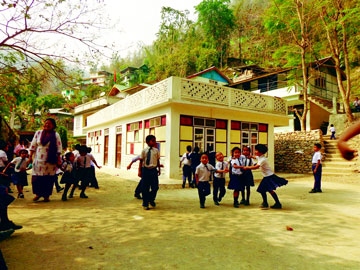
Ar. Rakhi has come a long way starting her career with Centre of Science and Technology for Rural Development (COSTFORD) and now with Sustainable Environment & Ecological Development Society (SEEDS). This transitional voyage till Sikkim with SEEDS all the way from COSTFORD manifested her inspirations, learning and understandings into a reconstruction project for a government school wherein we adapted hybrid-indigenous technology for promoting disaster resilient, environmental friendly and low-cost technologies.
Conceptualisation of Ikra with RCC
In order to conform to meet the needs of safe construction using locally available material we decided to combine traditional and modern construction techniques to evolve the building form. With these considerations in mind an adaptation of ikra (bamboo) panel system into reinforced concrete construction frame structure was conceptualized. The ikra which was modified for the school is a traditional form of construction which consists of a timber framework with infill panels made using locally available bamboo. We worked with a team of local masons for adaptation of the local techniques. The gradual development of design which integrated the local technology-ikra into the modern RCC evolved a composite type of construction, 'hybrid-ikra as an earthquake resilient model. This technology can be advocated to encourage local government to adapt and transform into local construction practices.
Restoration Goes Beyond Refurbishing
Restoration work helps building faith and strength amongst people about the damaged structures rather than just tearing them down, which further allows conservation instead a huge waste of energy and resources in new construction. To restore, to repair, to recover and to intervene have always been a part of the architect's actions for the recovery of the built environment. Benefits in energy saving, economic, ecological and cultural sustainability of the building recovery in comparison to the new construction are beyond doubt.
 |
While sharing her thoughts on physical infrastructure and social child-friendly, gender-friendly infrastructure like schools, cyclone and flood shelters, Ar. Rakhi says that her association with Development Professionals' Forum-Odisha as a Socio-Architect, brought her the opportunities to develop disaster resilient community architecture for the flood affected regions of Bihar, Odisha and West Bengal. "We designed and implemented numerous gender friendly flood shelters in extremely remote regions of this three states. The project aimed at significantly reducing disaster losses and building disaster resilient safe communities," she adds.
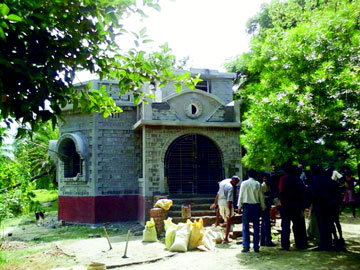
In Sandeshkhali Sunderbans, the perennial problem of girls trafficking and post cyclonic disaster, aggravated situations of girls between age 14-18 years. Due to further shrinking of livelihood creating livelihood opportunities for people and especially the vulnerable girls was a dire need to address the problem of girls withdrawn from trafficking. The vocational centers were built for skill building trainings in remote Sunderban villages of West Bengal for the vulnerable girls of age 14-18 years, who have been successfully withdrawn but could not join the mainstream schools due to learning gaps. We designed and implemented this load bearing structure in cost-effective technologies using rat-trap bond and filler slabs. The idea behind this was also to help the community to adapt to the safe and cost effective construction practices in case of future cyclonic disasters.
 |
She says, "I have worked as a socio architect in the humanitarian sector since last 5 years and indulged mostly in post-disaster reconstruction and recovery projects. Over the period of 5 years in the experience of implementing disaster prone structures I have learned a very simple mantra- "Serve the safety of the community, designs will take shape likewise." Thus the main principle, while involved in reconstruction works in disaster prone regions that I personally follow is the aim to achieve the safety of community so that I can contribute my expertise to make them resilient to cope with future disasters. During designing and construction process I make sure we involve community and make the restoration works as a participatory process. We hope to make an impact on communities and people on mitigating natural hazards and disasters by building disaster resilient architecture."
Cost Effective Technologies for Urban Poor
Ar. Rakhi has worked and played a key role on settlement projects for urban poor like micro resilient projects for urban communities for flood prone cities like Gorakhpur in sub Himalayan plains in Uttar Pradesh. Project aimed at developing a live learning model of a climate resilient and cost-effective house and school for urban community within a city. "We aimed at reducing loss of community assets through constructions that are cost-effective and resilient to local impacts of climate change. The project developed mechanisms of people-driven resilience systems and shared experiences and lessons in implementing climate resilient urban community model of low cost house and school for urban poor affected by the floods in the city. The project also won the prestigious 2013 UNFCCC Lighthouse Activity Award," she states.
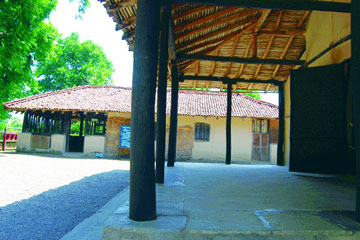
There is no particular answer for any widely known technologies. It's mostly dependent on the materials available locally and local construction capacity. E.g. ikra construction prevalent in earthquake zone of Sikkim is not suitable in the flood prone regions of Gorakhpur and similar other cities. Or for say, RCC construction prevalently practiced in cities are costlier in remote locations due to material and skill challenges. What can be said more specifically is that steel and cement being easily available, safe construction practices in prevalent practices need to be promoted for better awareness amongst people for safe construction practices? But if alternatives are available for steel and cement for any specific region like mud and bamboo, such technologies should be promoted for habitat settlements.
 |
Thus, a massive change is needed in order to harmonize construction industry with the environment. This may as well be one of the principal characteristics of the 21st century architecture. Ar. Rakhi opines that architecture, like any craft, is organic, evolving form; and traditional patterns are not the rigidity-structured creations of individuals but the collective experience of many generations. We must draw collective inspiration from the work of successive generations of builders, from the imprint of the environment and those who have lived in it, rather than brutally destroying them to satisfy our superficial egos for new construction.
Author
Ar. Rakhi Kashyap is Manager-Technical,
SEEDS (Sustainable Environment & Ecological Development Society)